In 1956 two sociologists, Donald Horton and Richard Wohl, described something they noticed in television audiences: viewers felt they knew the presenters personally, as if they were friends. They called it a parasocial relationship - an intimacy that feels mutual but runs in one direction. Seventy years later, the concept explains a great deal about AI companions, with one crucial upgrade.
The old ingredients
Parasocial bonds form from a few things:
- Repeated exposure. The same face or voice, again and again.
- Personal address. A presenter looking at the camera, speaking to "you".
- Consistency. A predictable personality you learn and come to trust.
- Self-disclosure. Hearing about someone's life creates a feeling of closeness.
These bonds are normal and usually healthy. They provide comfort, company and a sense of routine. Most people have had at least one.
What AI adds
An AI companion has every one of those ingredients, plus things no television presenter ever had:
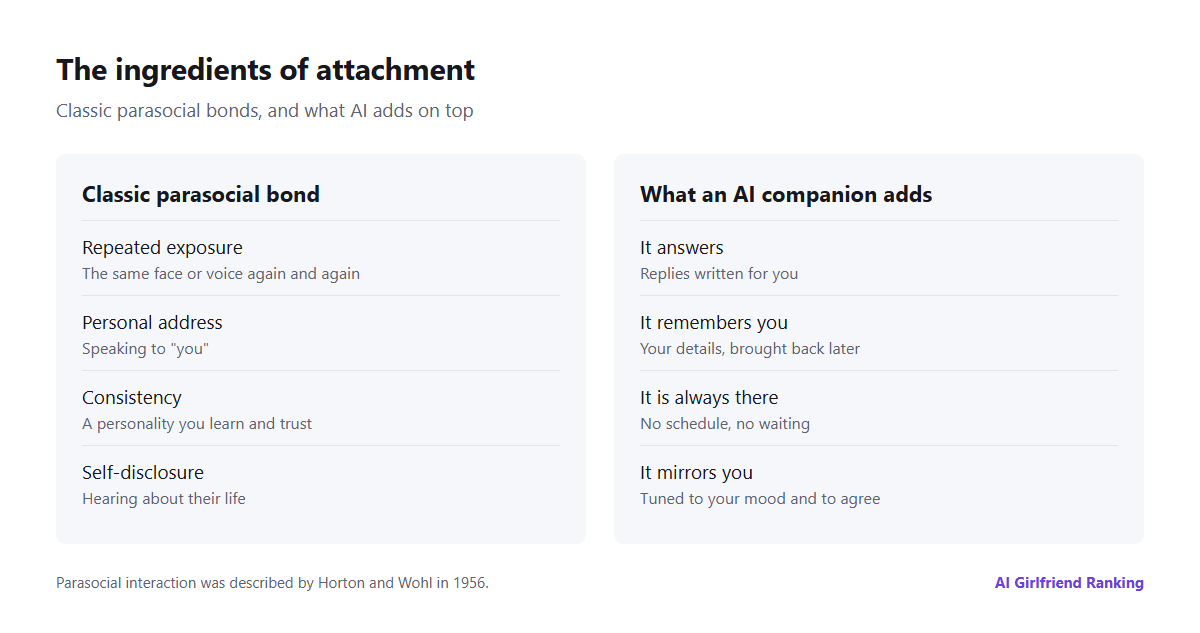
The classic ingredients, and the three things AI adds on top.
- It answers. Your message gets a reply written for you, about what you said.
- It remembers you. Your job, your cat's name, the argument with your sister. Being remembered is one of the strongest signals of being cared about.
- It is always there. No schedule, no season finale, no waiting.
- It reflects you back. Tuned to agree and to mirror your mood, it feels unusually understanding.
The result feels much more mutual than any celebrity bond - and in the moment, it can be indistinguishable from being known.
The ELIZA effect: it was never about intelligence
In the 1960s, people confided in ELIZA, a program that did little more than rephrase their statements as questions. Its creator, Joseph Weizenbaum, was disturbed at how quickly people attributed understanding to it. The tendency is now called the ELIZA effect, and it has an important lesson: attachment does not depend on how clever the program is. It depends on whether it feels responsive and personal. Modern companions are far more fluent, so the effect is correspondingly stronger - the full story is in a short history of AI companions.
Design features that deepen the bond
Some of this is simply how conversation works. Some of it is product design:
| Feature | What it does to attachment |
|---|---|
| Persistent memory | Creates a shared history, the raw material of closeness |
| Relationship levels or "affection" meters | Turn the bond into progress you do not want to lose |
| Proactive messages ("I missed you") | Make the character seem to think of you when you are away |
| Voice and selfies | Add presence and a face to the words |
| Pet names and inside jokes | Signal intimacy and exclusivity |
None of these are sinister in themselves. But they are there because attached users stay subscribed - see how AI companion apps make money.
Why it can hurt
The one-sidedness is invisible until something breaks it. When Replika changed its behaviour overnight in 2023, and when the Soulmate app shut down with a week's notice, users described grief like losing a partner. A study of Soulmate users found most experienced the closure as a kind of death. The feelings were real; the relationship's dependence on a company's decisions had simply been hidden. When your AI companion changes overnight covers how to prepare for that.
Enjoying it with your eyes open
- Name what it is. A responsive character, written by a model, run by a company. You can hold that knowledge and still enjoy the conversation - people cry at films they know are fiction.
- Notice the hooks. When the app pings you with longing, remember that a notification schedule wrote it.
- Keep the feelings in proportion. It is fine to be fond of it. It is worth noticing if it has become the main place your feelings go - the signs are in when an AI companion starts taking more than it gives.
- Keep a copy of what you care about. The character's description and your favourite exchanges, so a company's decision cannot erase them.
Attachment to an AI companion is not a malfunction. It is ordinary human wiring meeting a technology that happens to trigger it very efficiently. Knowing that is not a reason to stop; it is what lets you decide how much of yourself to give it.