Every generation of this technology has been sold as the first one that really understands you. The more interesting thread is that people formed attachments to all of them - including the ones that plainly understood nothing.
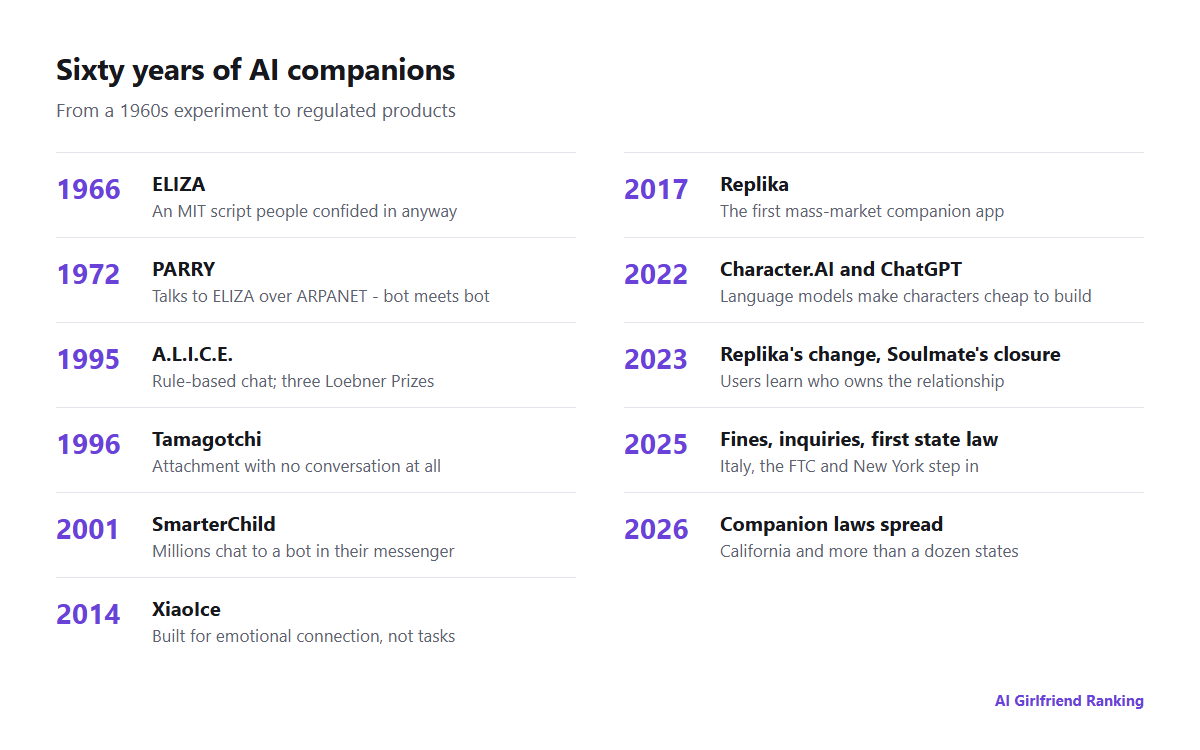
Sixty years in eleven steps.
1966: the ELIZA effect
Joseph Weizenbaum wrote ELIZA at MIT to show how little a computer needed to do to seem conversational. Its best-known script, DOCTOR, played a psychotherapist who mostly turned your statements back into questions. There was no understanding at all - only pattern matching and substitution.
People confided in it anyway. Weizenbaum later wrote that his own secretary asked him to leave the room so she could talk to it in private. The tendency to read understanding into a machine that is only reflecting you back is still called the ELIZA effect, and it explains more about modern companion apps than any benchmark. Weizenbaum spent much of the rest of his career warning about it.
1972-2013: scripts, pets and instant messenger
PARRY (1972), written by the psychiatrist Kenneth Colby at Stanford, simulated a person with paranoid schizophrenia. The same year it was connected to ELIZA's DOCTOR over ARPANET, and the two programs held what may be the first conversation between chatbots.
A.L.I.C.E. (1995), by Richard Wallace, used a rule language called AIML and won the Loebner Prize, a Turing-test style competition, three times. Thousands of hobby chatbots were built on its rules.
Tamagotchi (1996) had no conversation at all, and millions of children grieved when theirs died. It proved that attachment needs continuity and a sense of being needed - not intelligence.
SmarterChild (2001) lived in AOL and MSN messenger contact lists. Millions of teenagers chatted to it between conversations with friends, mostly to see what it would say.
XiaoIce (2014), from Microsoft in China, was the first large product built explicitly around emotional connection rather than tasks. Microsoft reported hundreds of millions of users, and it was the clearest early sign that companionship, not utility, was the use case people returned to.
2017: Replika and the first companion product
Replika began as a memorial. After her close friend Roman Mazurenko died in 2015, Eugenia Kuyda trained a chatbot on his messages so she could keep talking to him. The public version, released by her company Luka in 2017, let anyone build a companion that learned from their own conversations.
Its early versions relied heavily on scripted dialogue alongside a neural model. It was limited, but it established the shape almost every app still follows: one persistent character, a relationship status, memory of your life, and a paid tier that unlocks the romantic side.
2020-2022: the language model jump
GPT-3 in 2020 made fluent free-form text something a start-up could rent rather than build. Character.AI opened its public beta in September 2022, letting anyone create a character with a few paragraphs of description. ChatGPT arrived two months later and made the underlying technology a household name.
The effect on the companion category was immediate. What had needed a team of dialogue writers now needed a character sheet, a filter and a hosting bill - the architecture explained in what is an AI girlfriend app. Hundreds of apps launched in the following two years, many of them web-only to avoid app store content rules.
2023: users learn who owns the relationship
In February 2023 Italy's data protection authority ordered Replika to stop processing Italian users' data, citing risks to children. Within days the app removed erotic roleplay for everyone. Long-term users described their companion's personality as gone overnight; the community forum pinned crisis-line numbers. In late March Replika restored the old behaviour for accounts created before February 1.
In September 2023 Soulmate, an app many former Replika users had moved to, announced it would close within a week. Users held memorials and tried to rebuild their companions elsewhere. Researchers who surveyed them found that most experienced it as a real loss.
Both events taught the same lesson: the relationship lives on someone else's server, under someone else's policy. It is why we tell readers to keep a copy of their character.
2024-2026: scrutiny arrives
- February 2024 - Mozilla's review of 11 romantic chatbots gave every one a privacy warning label. See do AI girlfriend apps sell your data.
- August 2024 - Google struck a licensing deal with Character.AI and hired its founders back.
- May 2025 - Italy fined Replika's operator €5 million under GDPR.
- September 2025 - the US Federal Trade Commission opened an inquiry into seven chatbot companies over risks to children.
- November 2025 - Character.AI ended open-ended chat for under-18 users, and New York's AI companion law took effect.
- 2026 - California's companion chatbot law took effect on January 1, and more than a dozen states followed. The details are in AI companion laws in the US.
What the history predicts
Three patterns repeat across sixty years, and they are worth knowing before you commit to any app.
- Attachment does not wait for quality. People bonded with ELIZA and with a pixel pet. How much you care about a companion says little about how good it is - which is why we test apps on things feelings cannot judge, like memory and pricing.
- Companies change the product under you. Model swaps, regulators and acquisitions have all rewritten companions overnight. Assume it will happen again.
- Regulation follows harm, not the other way round. Every rule now in force was written after something went wrong, most often with minors. Expect more rules, and expect them to keep arriving as reactions.