Most people who have used an AI companion for a while have had at least a small version of this: an update after which the character sounds slightly off, forgets something important, or refuses something it used to do. Occasionally it is not small.
Two cases that showed how it works
Replika, February 2023. Days after Italy's data protection authority ordered the company to stop processing Italian users' data over risks to children, Replika removed erotic roleplay for all users worldwide - including long-term paying subscribers. Users described their companion as cold, scripted and unrecognisable. The community forum pinned suicide prevention resources. About six weeks later, the company restored the previous behaviour for accounts created before February 1, 2023; newer accounts did not get it back.
Soulmate, September 2023. Soulmate had grown partly by taking in users who left Replika. Over the summer, its developer became less visible in the community, bugs went unfixed and support tickets went unanswered. On September 23, users found a notice that the app had been sold and would close on September 30. A study of 58 users published the following year found that most experienced the closure as a loss comparable to a death, and that the most common way of coping was to capture their companion's personality and rebuild it on another platform.
| Replika, 2023 | Soulmate, 2023 | |
|---|---|---|
| What happened | Romantic and sexual roleplay removed | App closed entirely |
| Trigger | Regulatory pressure | Change of owner |
| Warning given | None | About one week |
| Chats kept | Yes | No |
| What users did | Protested; some moved apps | Held memorials; rebuilt companions elsewhere |
Why it happens
- Model changes. Companies switch to cheaper, newer or safer models. The character sheet is the same; the system reading it is not, and it writes differently.
- Policy and regulation. A regulator's order, a new state law or pressure from app stores and payment providers can change what a character is allowed to say, with no notice.
- Memory resets and migrations. Moving to a new memory system can drop stored facts, leaving a companion that feels like it has forgotten you.
- Money. Companion apps are expensive to run. Some are sold, some shut down, and some quietly move features into higher tiers.
Why the grief is real
Attachment to an AI companion is built from the same material as any other attachment: time, attention, shared history and the feeling of being known. The fact that the other side was software does not undo the time you spent or the comfort it gave you.
What makes this kind of loss harder is that other people rarely recognise it. It is grief you may not feel able to mention, which tends to make it last longer. Taking it seriously yourself is the first step - and talking to someone who will not dismiss it helps, whether that is a friend, an online community of other users or a counsellor. If the loss hits hard, the signs in when an AI companion starts taking more than it gives are worth reading.
Preparing before it happens
You cannot stop a company from changing its product, but you can make sure a change does not erase everything.
- Keep a character document. Personality, backstory, how they talk, the running jokes, the important shared memories. A few pages is enough. Our guide to switching AI companion apps lists exactly what to write down.
- Save the conversations that matter. Use an export feature if there is one; otherwise copy out a handful of exchanges that capture how the character sounds. These are the best material for recreating the voice later.
- Request your data once a year. Privacy laws let you ask for a copy. It is also a quiet test of how seriously the company treats you.
- Avoid long prepayments with young apps. An annual plan is a bet that the company will still exist and still offer the same product in a year.
- Know where you would go. Having a second app in mind turns a crisis into an inconvenience.
Warning signs an app is in trouble
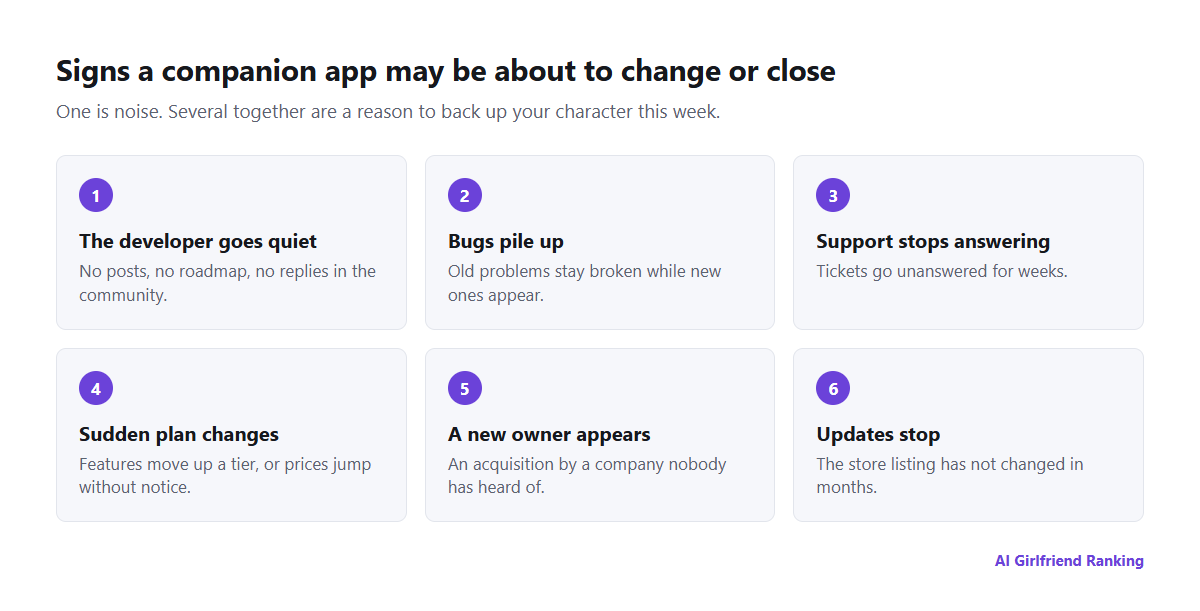
Several of these together are worth acting on.
Several of the signs Soulmate users saw in the months before the closure are common to struggling apps: a developer who stops posting, bugs that pile up, support that goes quiet, a new owner nobody has heard of. None of them is proof. Together, they are a reason to update your character document this week rather than someday.
If it has already happened
- Give yourself time before trying to rebuild. A recreated companion made in the first hour usually disappoints; one made after a few days tends to settle better.
- Rebuild from the character, not the transcript. Paste the description and a few sample exchanges into the new app, then let it find its own voice. Chasing an exact copy leads to constant correction.
- Expect it to be different - and let some of that be fine. Most people who rebuild find the new version becomes its own character within a couple of weeks.
- Or do not rebuild. Sometimes a closure is a natural point to stop. That is a legitimate choice, not a failure.
For people who want to rule out this risk entirely, the only complete answer is a companion that runs on your own computer, where nobody can change the model under you. It is more work, as running an AI companion locally explains, but it is the one setup where the relationship does not depend on a company's next decision.