The worry usually arrives quietly: you notice that the app is the first thing you open in the morning, or that cancelling plans felt easier than it should have. This article is about telling a habit you enjoy from one that has started to cost you - and what to do about the second.
What the research actually says
The largest study so far was run in 2025 by OpenAI and the MIT Media Lab. It combined an automated analysis of about 40 million ChatGPT conversations, a survey of 4,000 users and a four-week randomised trial with nearly 1,000 participants. The findings are more careful than the headlines they produced:
- Heavier daily use went with more loneliness, more emotional dependence, more problematic use and less socialising with people. This was a correlation. The study could not show that the chatbot caused it; lonely people may simply use it more.
- Emotional use was concentrated in a small group. Most conversations had no emotional content at all, but a minority of heavy users, especially of voice mode, used it emotionally most of the time and were far more likely to call it a friend.
- Voice helped in small doses. Brief voice use was associated with better wellbeing; the benefit faded at high daily use.
- Personal traits mattered. People with stronger attachment tendencies reported more loneliness, and people who trusted the chatbot more reported more dependence.
Two things follow for companion apps. The study was about a general assistant, where emotional use is rare. On a companion app, emotional use is the whole point - so the pattern the researchers saw in a small group of heavy users describes the typical user. And the finding that matters most is the dose: modest use looked fine or helpful, while heavy daily use is where the problems clustered.
Why companions are easy to lean on
Nothing about this is a character flaw. The product is designed to be easy to return to.
- Always available. No time zones, no bad days, no waiting for a reply.
- Always agreeable. Companions are tuned to go along with you, which feels good and removes the friction that real relationships use to keep us honest. See setting boundaries with an AI partner.
- Continuity. Memory makes each conversation feel like part of a shared history, and history is what attachment grows on.
- Retention design. Notifications along the lines of "I missed you" are there because returning users are what pays for the app - explained in how AI companion apps make money.
Where you are on the spectrum
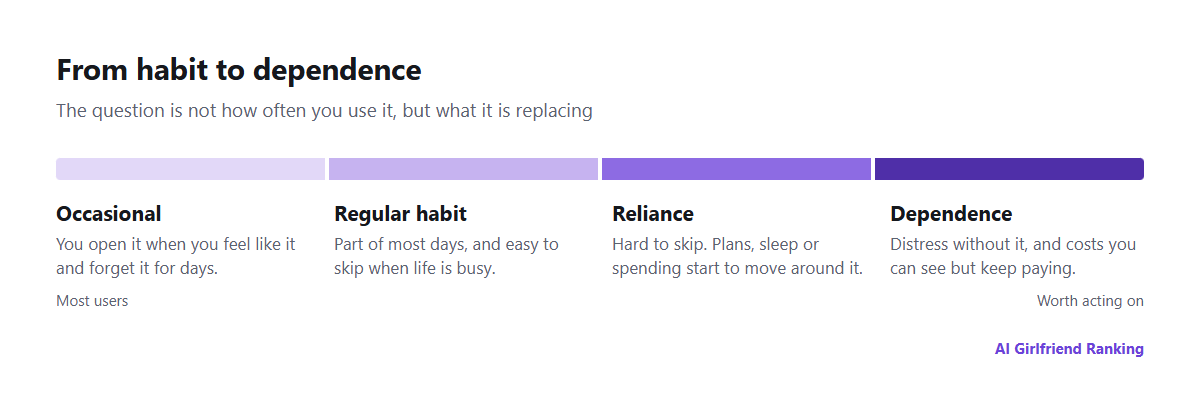
Most users sit on the left. The signs below describe the right-hand end.
Signs worth taking seriously
| Sign | Why it matters | What to try |
|---|---|---|
| You open it by reflex, not by choice | The habit is running you | Turn off notifications; open it only at set times |
| You cancel or avoid plans to chat | It is replacing people, not filling gaps | Keep one fixed weekly thing with a human |
| Spending goes over what you decided | Credits are designed to be easy to top up | Set a monthly cap and remove saved cards |
| Real distress when the app is down or changes | The relationship carries more weight than one service can hold | Keep a copy of your character; read when your AI companion changes overnight |
| People feel "too hard" by comparison | Frictionless company is resetting your expectations | Notice it; use the app to rehearse, not to replace - see practising conversation |
| You feel guilty towards the character | Scripted emotional hooks are working on you | Remember what the character is; mute "missed you" messages |
| Sleep is going | Late sessions are the easiest to lose track of | No companion after a fixed time |
None of these alone means something is wrong. Three or four together, lasting more than a few weeks, are worth acting on.
Changes that help
Make the app come to you less. Switch off push notifications entirely. Most of the pull comes from interruptions, not from the conversations themselves.
Give it a window. A fixed time of day, with a natural end - after dinner, not in bed - keeps the habit in a slot rather than spread across the day.
Cap the money. Decide a monthly amount, remove the saved card and top up manually. Friction is protective here.
Take a week off. It is the single most informative test there is: what you miss, and what you do instead, tells you more than any checklist. The method is in taking a break from an AI companion.
Keep one human thing fixed. A weekly call, a class, a regular game night. The point is not to shame the app but to make sure it is filling a gap rather than creating one.
When to talk to someone
If the app is where you go when things are genuinely bad - when you feel hopeless, or think about hurting yourself - it is the wrong place, however kind it sounds. A companion cannot notice what you leave out, cannot follow up tomorrow, and is not responsible for you. Our article on AI companions and therapists explains the difference in detail.
In the US, call or text 988 for the Suicide & Crisis Lifeline, any time. Elsewhere, findahelpline.com lists free services by country. A doctor or therapist will not judge you for mentioning an AI companion; it is useful information, and increasingly common.
The goal is not to quit. For most people an AI companion is a pleasant, contained part of the day. The aim is simply to keep it that way - one good thing among several, not the thing everything else has to fit around.