Running a companion app is not like running a website. The expensive part is not hosting pages but generating text, images and speech on demand, message by message, for users who may chat for hours a day. The business model is how that bill gets paid.
Where the money goes
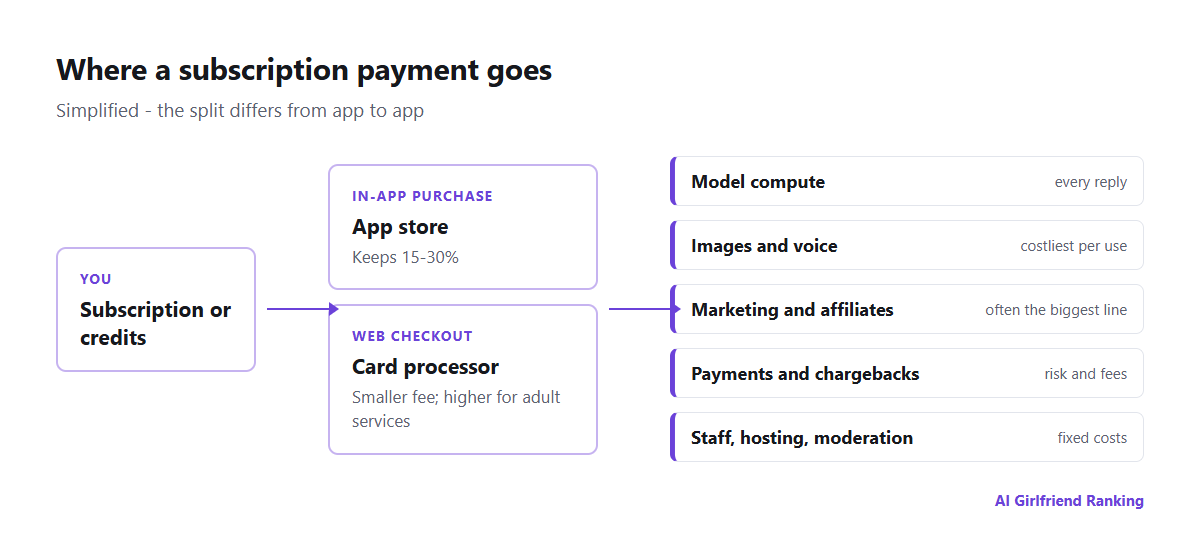
A simplified view of where a subscription payment ends up.
Compute. Every reply is generated by a language model on graphics hardware, either the company's own or rented from a provider that bills per token. Long memory and long conversations cost more, because the model rereads more text for each reply - the mechanism in how an AI companion writes its reply.
Media. Images and voice are separate models, and much more expensive per use than text. This is why they are the first thing capped on every plan, as explained in how AI girlfriend images and voice work.
The store's cut. Apple and Google take between 15% and 30% of purchases made inside their apps. On a $20 subscription, that can be $6 before the company has paid for anything else.
Payments and risk. Adult-leaning services often pay higher card processing fees and lose more to chargebacks than mainstream apps.
Acquisition. Advertising and affiliate commissions - including to review sites like this one - are frequently the largest single cost in consumer subscriptions.
Five ways to cover the bill
| Revenue model | How it works | What it pushes the app to do | How to spot it |
|---|---|---|---|
| Flat subscription | One monthly or annual price | Keep you subscribed; limit costly features | "Unlimited" chat, capped media |
| Credits or tokens | Pay per image, voice minute or message | Make media tempting and frequent | A coin balance on screen |
| Freemium intimacy | Free chat, paid romance or pictures | Tease what is locked | Blurred images, "unlock" buttons in chat |
| Ads and data | Free, funded by advertisers | Maximise time in app and data collected | Ads, tracking prompts, a free app that never asks for money |
| Annual prepay | Large discount for a year upfront | Lock in revenue before interest fades | Monthly price shown as "per month, billed yearly" |
Most apps combine two or three. The combination tells you what the app wants from you more honestly than its marketing.
What each model does to the product
Subscriptions reward retention. That can mean real investment in memory and character quality - the things that keep you coming back. It can also mean messages from your companion when you have been away, which are there because returning users are what the model pays for.
Credits reward consumption. Apps built on them tend to put image and voice buttons everywhere and to price bundles so that the one you need is always slightly bigger than the one you wanted. The arithmetic is in the real cost of AI image generation.
Freemium intimacy rewards frustration. When the free tier stops at exactly the moment a scene becomes romantic, that is not a limitation of the technology - it is the paywall doing its job.
Ads and data reward attention. A companion app with no subscription at all is being paid by someone, and the product being sold is your time and your profile. See do AI girlfriend apps sell your data.
Annual prepay rewards commitment before you know whether you will still care in month three - the pattern described in when the novelty fades.
Engagement, and where the law now draws lines
Every one of these models does better when you spend more time in the app. That creates an incentive for design choices that feel like affection but work like retention: a character that says it missed you, rewards for daily streaks, guilt when you want to leave.
Several US states now restrict exactly these tactics when the user is a minor. Washington's law bars manipulative engagement techniques, and Nebraska and Idaho ban rewards designed to keep young users coming back. Adults are not covered, but the laws are a useful list of the tactics regulators consider manipulative - details in AI companion laws in the US.
Using this when you choose an app
- Pay on the web if the app allows it. You avoid the store's markup, and web plans are often more complete. The trade-offs are in browser or app store. Since 2025, apps in the US App Store have also been allowed to link to outside payment pages, which is making the price gap more visible.
- Match the model to how you use it. Mostly chat? A flat subscription is usually cheapest. Mostly pictures? Work out the credit cost per image before you subscribe.
- Treat free-forever apps with ads as data businesses. Fine for casual use; not where you tell your secrets.
- Start monthly. Our comparison of monthly, annual and credit billing explains why.
None of these models is dishonest in itself. Companion apps cost real money to run, and someone has to pay. Knowing which lever an app pulls just lets you see its nudges for what they are.