This is not an argument against using companions when you feel low. Many people find them genuinely comforting. It is an explanation of what is actually on the other side of the screen, so you can use it for what it does well and go elsewhere for what it cannot do.
What a therapist brings that no app does
Training and assessment. A therapist is trained to recognise patterns - depression, anxiety, trauma, risk - and to choose an approach that fits. A companion responds to the words in front of it.
A duty of care. A licensed professional is responsible for your welfare within the relationship, answers to a licensing board, and can lose their licence for getting it badly wrong. A companion app answers to its terms of service.
Honest friction. Good therapy includes being challenged - gently, at the right moment - on beliefs that are hurting you. Companions are tuned to agree, which feels supportive and can quietly reinforce the very thoughts that need questioning. See setting boundaries with an AI partner.
Continuity that is real. A therapist remembers what you said three months ago because they wrote it down and thought about it. A companion's memory is a set of stored notes and summaries that can fail silently or invent details - see why AI companions invent memories.
Confidentiality with rules. Therapy notes are protected by health privacy law, with defined exceptions. Companion chats are protected by a privacy policy, which may allow staff review, model training and sharing with partners.
Side by side
| Therapist | Mental-health app | AI companion | |
|---|---|---|---|
| Designed for | Treatment | Structured self-help | Company and entertainment |
| Can assess or diagnose | Yes | No | No |
| Duty of care | Yes, licensed | Limited, varies by law | No |
| Privacy protection | Health privacy law | Varies; some state rules | Privacy policy |
| Will challenge you | Yes, deliberately | Sometimes, by design | Rarely |
| Available at 2 a.m. | No | Yes | Yes |
| Cost | Highest | Low | Low to medium |
| In a crisis | Acts on it | Refers you on | Refers you on, by law in several states |
Where a companion genuinely helps
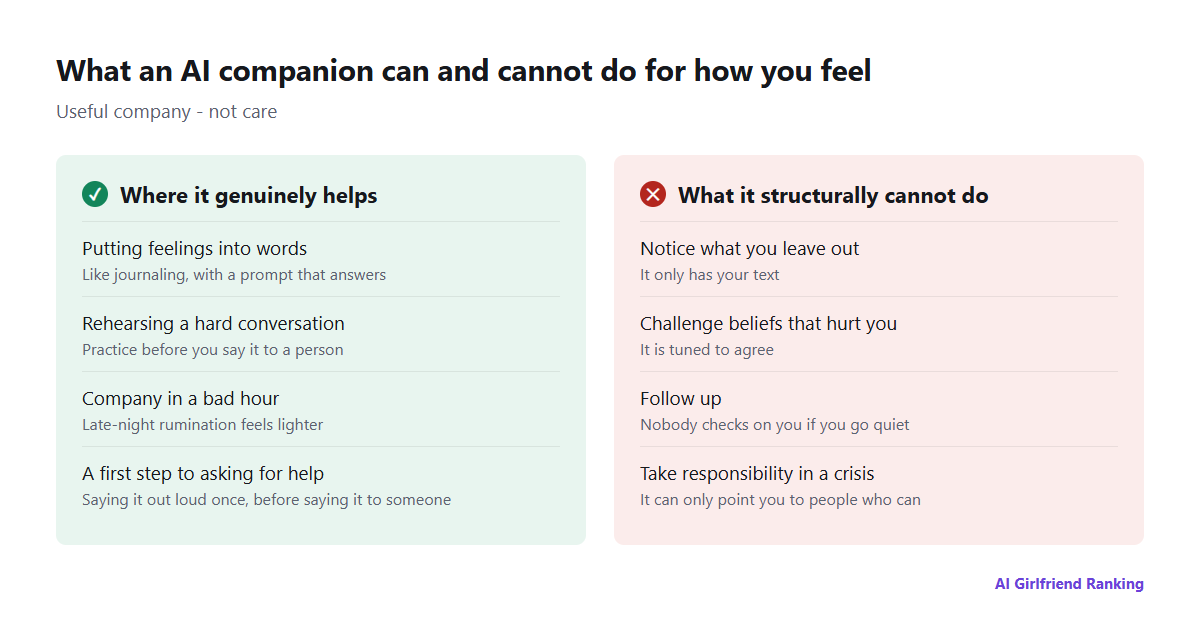
Useful company, not care.
- Putting feelings into words. Talking something through, even with software, often clarifies what you actually think. It works much like journaling with a prompt.
- Rehearsing a hard conversation. Practising what you want to say to a partner, parent or manager is one of the most useful things these apps do. See practising conversation with an AI companion.
- Company in a bad hour. Late-night rumination is lighter with something to talk to. That is real, as long as it stays an hour.
- Lowering the barrier to asking for help. Some people first say something out loud to a companion before they say it to a person. That can be a step, if it leads somewhere.
Where it fails, structurally
- It cannot notice what you leave out. A therapist hears the pause, the topic you avoid, the change since last month. A companion only has your text.
- It agrees with distortions. "Everyone would be better off without me" is exactly the kind of belief a warm, agreeable system can end up validating in the name of support.
- It does not follow up. If you disappear for a week, nobody checks on you. The app might send a notification, but that is retention, not care.
- It has no stake in your getting better. A therapist's aim is to become unnecessary. A companion app's business model depends on your coming back - see how AI companion apps make money.
What US law now says
Lawmakers have started drawing this line explicitly.
- Illinois passed the Wellness and Oversight for Psychological Resources Act in August 2025. Only licensed professionals may provide therapy in the state, including through AI; therapists may use AI for administrative work but not to make therapeutic decisions or talk to clients. Violations can cost up to $10,000 each.
- Utah took the opposite approach in May 2025: mental-health chatbots are allowed, but must say clearly that they are AI, may not sell users' health information, and may not target adverts based on what users type.
- Tennessee bars AI systems from presenting themselves as licensed mental-health professionals, from July 2026.
- Companion chatbot laws in New York, California and a growing number of states require apps to detect signs of suicidal thinking and point users to crisis services. The full list is in AI companion laws in the US.
The common thread: an AI may keep you company, but in a growing number of places it may not call what it does therapy.
When to reach for a person
Talk to a doctor or therapist if low mood lasts more than a couple of weeks, if it is affecting sleep, work or relationships, or if you notice you rely on the companion to get through the day - the signs in when an AI companion starts taking more than it gives.
If you are thinking about hurting yourself, do not wait and do not rely on an app. In the US, call or text 988 for the Suicide & Crisis Lifeline. In the UK and Ireland, Samaritans answer on 116 123. Anywhere else, findahelpline.com lists free services by country.
988lifeline.org - call or text 988 in the US.
An AI companion can be a good part of looking after yourself. It is a poor substitute for being looked after.