A useful rule when reading any statistic about AI companions: ask who counted, what they counted, and where. Mobile app data misses web-only services. Surveys depend on how the question was worded. Market "forecasts" are often marketing.
Headline figures
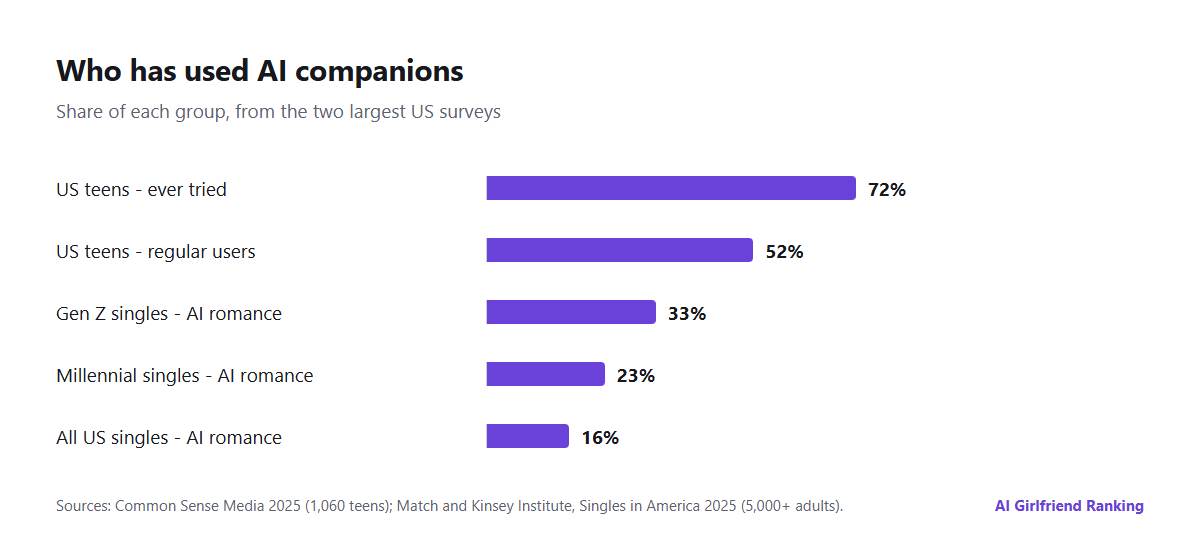
Share of each group who have used AI companions, from the two largest US surveys.
| Figure | Value | Source and date | What it measures |
|---|---|---|---|
| Lifetime downloads of companion apps | 220 million | Appfigures, July 2025 | App Store and Google Play only |
| In-app revenue, first half of 2025 | $82 million | Appfigures | Mobile stores only; web sales excluded |
| Projected 2025 in-app revenue | Over $120 million | Appfigures | Projection, mobile only |
| Active revenue-earning companion apps | 337 | Appfigures, mid-2025 | 128 of them launched in 2025 |
| Share of revenue taken by top 10% of apps | 89% | Appfigures | A highly concentrated market |
| US teens who have tried an AI companion | 72% | Common Sense Media, 2025 | 1,060 teens aged 13-17 |
| US teens who use them regularly | 52% | Common Sense Media, 2025 | At least a few times a month |
| US singles who have interacted with AI as a romantic companion | 16% | Match and Kinsey Institute, 2025 | 5,000+ adults; see note below |
| Of Gen Z singles | 33% | Match and Kinsey Institute, 2025 | |
| Singles who say an AI partner counts as cheating | 40% | Match and Kinsey Institute, 2025 |
Note on the Match figure: according to reporting on the survey, "interacting with AI as a romantic companion" may include people who used AI to help with dating profiles and messages, not only people with an AI partner. Treat it as an upper bound.
What people use them for
From the Common Sense Media teen survey:
- A third of teens used AI companions for social interaction and relationships, including conversation practice, emotional support, roleplay and romance.
- 39% of teen users said they had carried social skills practised with AI into real life.
- 31% found AI conversations as satisfying or more satisfying than those with friends, but 80% still spent more time with real friends.
From the Match adult survey, among singles with AI partners: 45% said AI made them feel more understood, and 44% said it offered stronger emotional support than people.
The market is small, concentrated and growing
Compared with the whole consumer AI market - over $1.4 billion of app spending in 2024 by Appfigures' count - companion apps are a small slice. But they grew fast: downloads in the first half of 2025 were up 88% on the year before, and revenue per download more than doubled. A handful of apps earn almost everything; most of the hundreds of apps in the category earn very little.
Two things the mobile figures miss:
- Web subscriptions. Many adult-oriented companion apps sell mainly or only on the web, partly because of app store content rules. Their revenue does not appear in app store data - see browser or app store.
- General chatbots used as companions. Some people use ChatGPT, Claude or Grok in a companion-like way. The OpenAI and MIT research found emotional use of ChatGPT was rare overall but concentrated in a small group of heavy users.
Statistics to be careful with
- "The AI companion market will be worth $X billion by 2030." Market-size forecasts vary by orders of magnitude and usually come from firms selling reports.
- Counts of "users" from the apps themselves. Registered accounts are not active users.
- Engagement figures for single characters such as minutes per day, which often come from unsourced blog posts.
- Percentages without a base. "40% of users" of what, surveyed how?
Where to follow the numbers
Appfigures and other app intelligence firms publish category updates; Common Sense Media and the Match/Kinsey Singles in America study repeat their surveys; academic studies on wellbeing are summarised in do AI companions help mental health. How the money in the category is made is explained in how AI companion apps make money.