The honest summary is short: AI companions reliably make people feel less lonely in the moment, a small group of heavy users seem to do worse, and almost nothing is known about the long term. The details are more interesting than either headline.
The main studies at a glance
| Study | What was done | Main finding | Main limit |
|---|---|---|---|
| Maples et al., Stanford (2024) | Survey of 1,006 students using Replika | Users were lonelier than typical students; many described it as helpful. 3% said, unprompted, that it had stopped suicidal thoughts | Self-reported survey, no comparison group |
| De Freitas et al. (2024, published 2026) | Several experiments, including a week-long study | A session reduced loneliness about as much as talking to a person; feeling heard explained most of the effect | Short-term effects only |
| OpenAI and MIT Media Lab (2025) | ~40 million conversations analysed, 4,000 surveyed, ~1,000 in a 4-week trial | Heavier daily use went with more loneliness, dependence and less socialising | Correlation; a general chatbot, not a companion app |
| Common Sense Media (2025) | Survey of 1,060 US teens | 72% had used AI companions; 39% of users carried social skills into real life | Self-report; teens only |
What the evidence supports
Short-term relief is real. The strongest experimental evidence, from Julian De Freitas and colleagues, found that people felt less lonely after interacting with an AI companion - about as much as after chatting with another person, and more than after watching videos. Participants also underestimated how much it would help. The key ingredient was feeling heard.
Some people describe profound benefits. In the Stanford survey of Replika users, 30 of 1,006 students (3%) said without being asked that the app had halted suicidal thoughts. That is a striking figure, but it comes from open-ended comments in a survey, not a measured outcome - it tells us some people credit the app, not that the app caused the change.
Social practice can transfer. Among teens who used AI companions, 39% said they had used skills practised with the AI in real situations.
What the evidence warns about
Dose seems to matter. In the OpenAI and MIT research, higher daily use - of any kind - went with more loneliness, more emotional dependence and less time with people. Brief voice use was associated with better wellbeing; heavy use was not.
A small group carries most of the risk. Emotional use was concentrated among a minority of heavy users, who were far more likely to call the chatbot a friend. On companion apps, where emotional use is the norm, that group is likely to be larger.
Traits matter. People with stronger attachment tendencies reported more loneliness; those who trusted the chatbot more reported more dependence.
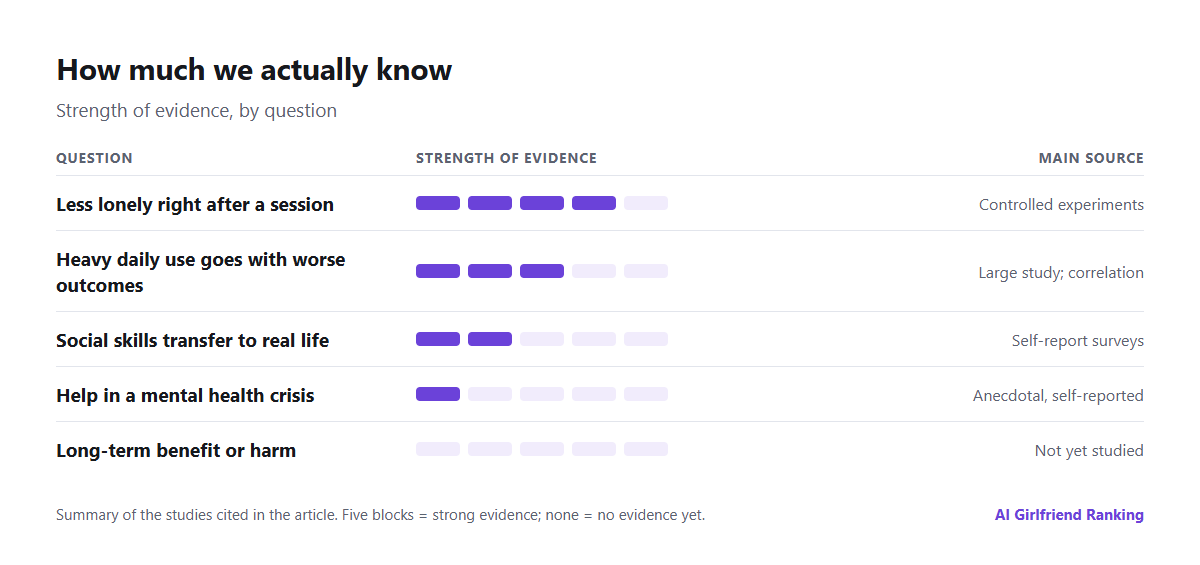
How much we actually know, by question.
What nobody knows yet
- The long term. No study has followed companion users for years. Whether short-term relief builds into lasting wellbeing, or whether reliance erodes it, is open.
- Cause and effect in heavy use. Lonely people may simply use companions more. The data so far cannot separate the two.
- Vulnerable groups. Almost no controlled research covers people with serious mental illness, or minors - which is part of why several US states now regulate companion apps for young users. See AI companion laws in the US.
Reading the research critically
- Check who ran it. The largest study of chatbot use was co-run by OpenAI. That does not make it wrong - its findings were not flattering - but it is worth knowing.
- Check the product. Findings about ChatGPT, a general assistant, do not automatically apply to companion apps designed for intimacy, and vice versa.
- Check the timescale. "After a session" and "after a year" are different claims.
- Check the measure. "Users said it helped" is weaker than "a measured outcome improved compared with a control group".
What this means for you
The evidence supports a moderate position: an AI companion can be a genuine comfort, particularly in lonely stretches, and brief regular use looks fine for most people. The warning signs appear with heavy daily use, especially when it starts displacing people - the signs are listed in when an AI companion starts taking more than it gives.
And for anything beyond everyday loneliness - persistent low mood, anxiety that limits your life, thoughts of self-harm - the research does not support using a companion instead of care. An AI companion is not a therapist explains the difference. In the US, 988 answers calls and texts at any time.