The shift is easiest to see in what people pay for. Traditional adult entertainment sells content to watch. Many AI companion apps sell something closer to a relationship: a character who replies, remembers and adapts. That changes the product, the business and the risks.
What AI changes
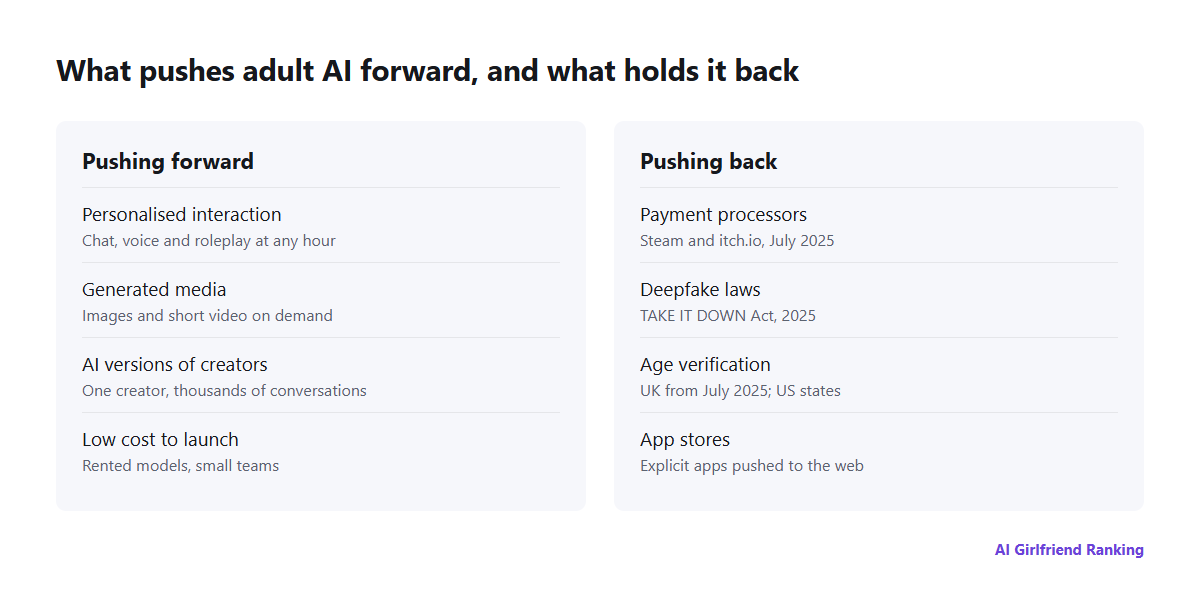
What pushes adult AI forward, and what holds it back.
- Interaction instead of consumption. Chat, voice and roleplay tailored to one person, at any hour.
- Generated imagery. Pictures and short videos of characters who do not exist, on demand. Cost and consistency are the limits - see the real cost of AI image generation.
- AI versions of real creators. Authorised clones let a creator "talk" to thousands of fans at once. The first famous example, CarynAI, also showed how quickly it can go wrong - see AI clones of real people.
- Scale for small operators. A small team can launch a companion product by renting a model, which is why hundreds exist.
What pushes back
Payment processors
Card networks and payment companies set rules for adult content that apply everywhere they operate. In July 2025, after a campaign directed at payment providers, Steam removed hundreds of adult games from sale and itch.io hid adult content, both citing their payment partners. AI companion apps rely on the same networks, so the same pressure can remove a feature or a payment method overnight.
Deepfake and image laws
The most serious harm in the space is sexual imagery of real people made without consent. In the US, the TAKE IT DOWN Act, signed in May 2025, made publishing non-consensual intimate images - including AI-generated ones - a federal crime, and since May 2026 platforms must remove reported images within 48 hours. When a 2025 leak at the Secret Desires platform exposed face-swapped explicit images of real women, it showed why lawmakers acted.
Age verification
The UK has required effective age checks for pornographic services, including AI tools that generate such content, since July 2025, and the US Supreme Court upheld state age-verification laws the same summer. Adult AI apps now have to verify users or switch features off by country - see age verification on AI companion apps.
App stores
Apple and Google restrict sexual content, which is why most explicit companion apps live on the web. See browser or app store.
How the business adapts
| Pressure | Typical response |
|---|---|
| Payment processor rules | Separate billing entities, careful billing descriptors, shifts in payment methods |
| App store restrictions | Web-first products, a tamer store version |
| Age-verification laws | Third-party age checks, or adult features switched off by country |
| Deepfake laws | Bans on uploading real faces; removal of face-swap features |
| Reputational risk | Adult features kept apart from mainstream branding |
Those responses explain things users notice: a billing name on a card statement that does not match the app (see payment privacy), a feature available in one country and not another (see blocked or limited countries), and sudden changes to what is allowed.
What it means for you as a user
- Expect instability. Adult features are the most likely to change or disappear. Avoid long prepayments.
- Protect your identity. Adult data is the most damaging to leak; use a separate email and keep your face out of it - see AI companion data breaches.
- Stay behind the hard lines. No minors, no real people's likeness, no sharing without consent - set out in consent in NSFW AI chat.
- Prefer operators who take the rules seriously. Age checks, real-face bans and clear billing are signs of a company planning to be around next year.
AI is making adult entertainment more personal than it has ever been. It is also putting it under more gatekeepers at once than it has ever faced. The apps that last will be the ones that deliver the first while respecting the second.