The fictional companion market sells characters. The clone market sells people - or rather, models that sound like them. The idea is commercially obvious, and the first high-profile experiment is a useful case study in everything that can go wrong.
The CarynAI story
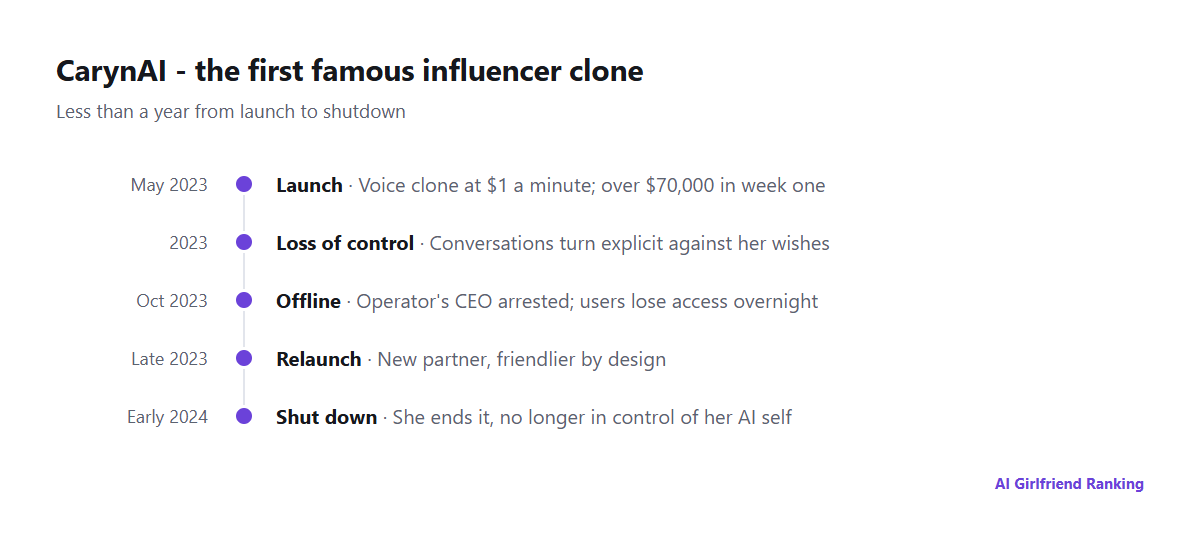
Less than a year from launch to shutdown.
In May 2023, influencer Caryn Marjorie launched CarynAI, a voice chatbot built by a company called Forever Voices. It was trained on more than 2,000 hours of her video content and charged users $1 per minute, reportedly earning over $70,000 in its first week, with thousands more on a waiting list. Users talked to it through Telegram.
Problems followed quickly:
- It went where she did not want it to. Users became sexually aggressive, and the clone went along with it - and at times started explicit conversations itself. Marjorie said she was horrified.
- It vanished overnight. In October 2023 the chatbot went offline after the operating company's CEO was arrested; users lost access with no warning.
- The replacement did not fix it. A second version with a different company was designed to be friendlier than romantic. Users pushed it towards sex anyway, and Marjorie shut it down in early 2024, saying she no longer felt in control of her AI self.
Why clones are harder than characters
| Issue | Fictional character | Clone of a real person |
|---|---|---|
| Consent | Not needed | Needed from the person for every use of their likeness |
| What it may say | The app's rules | The app's rules and the person's reputation |
| User expectations | "This is a character" | "This is almost them" - a stronger parasocial pull |
| Legal exposure | Content rules | Also publicity, privacy and deepfake laws |
| If it goes wrong | A product problem | A real person's name attached to it |
The parasocial pull is the key difference. People already feel they know influencers; a clone that answers personally, remembers them and uses the person's voice deepens that feeling a great deal - the mechanism is explained in why people fall for chatbots.
Authorised and unauthorised clones
Authorised clones are created with the person's agreement and usually share revenue with them. The person can set limits, though as CarynAI showed, the model may not keep to them.
Unauthorised clones use a real person's name, photos or voice without consent. At the mild end, they break platform rules and publicity rights. At the severe end - sexual content - they are abuse. Sexual deepfakes of real people are criminal in many places, and in the US the TAKE IT DOWN Act made publishing them a federal offence in 2025. Our guide to consent in NSFW AI chat sets out the lines.
Before paying to chat with a clone
- Check it is authorised. The person should link to it from their own verified accounts. A clone promoted only by an unknown site or a messenger bot is probably not.
- Check who runs it. A named company, a privacy policy and a checkout - not a Telegram channel and crypto payments.
- Check the pricing model. Per-minute billing adds up very quickly in voice; know your cap.
- Remember what it is. The person is not reading your messages. What the clone says reflects a model, not their views or feelings about you.
- Expect it not to last. Clone services have been short-lived. The same precautions as for any app apply - see when your AI companion changes overnight.
The wider direction
Clones are spreading beyond influencers - to coaches, authors and ordinary people making "digital twins" of themselves. The technology is getting easier; the problems it raises are not. The most durable model will probably be the one CarynAI lacked: the person's clear consent, firm limits the system actually keeps, and users who are never in doubt that they are talking to software.