This is a guide for adults who use AI companions for sexual roleplay and want to do it without harming anyone - including themselves. It is not about whether NSFW chat is acceptable; for consenting adults it is a legal and common use of these apps.
Who consent is actually about
The character is software. It cannot be hurt, and describing it as "consenting" is a figure of speech. But three kinds of real people can be affected:
- People who are not in the chat but are in the content. Anyone whose name, photo or likeness is used.
- People who see what you share. Friends, partners, strangers who receive screenshots or images.
- You. Your data, your wellbeing, and the habits a long-running fantasy can build.
The hard lines
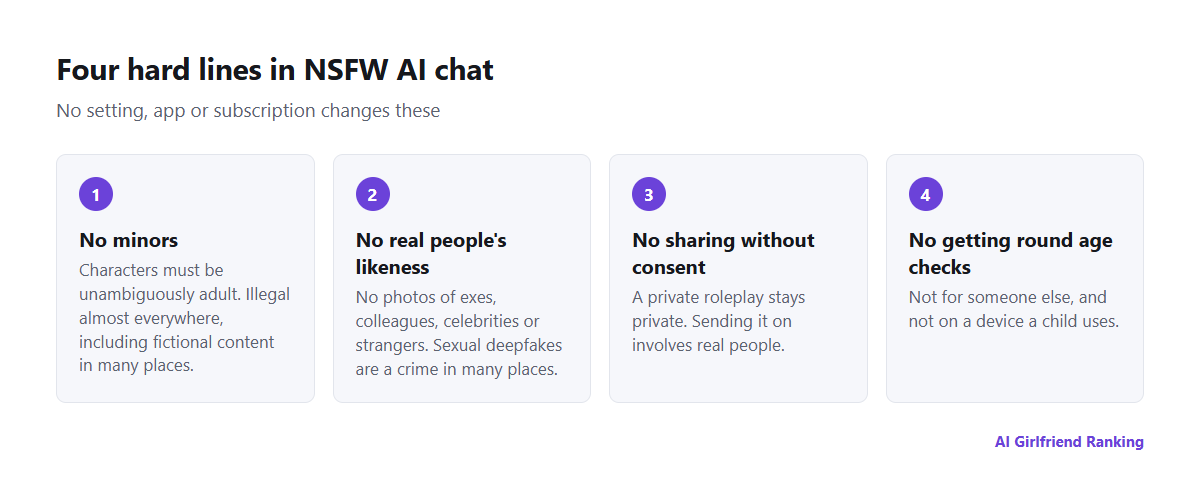
Lines that no setting or app changes.
Minors, in any form. Characters must be adults, clearly and unambiguously. Sexual content involving minors is illegal almost everywhere, and many jurisdictions include fictional and AI-generated material. Apps are required to block it, and prompts attempting it are stored - the 2024 breach of the Muah.ai site exposed exactly such prompts alongside users' email addresses.
Real people's likeness. Do not upload photos of real people - an ex, a colleague, a celebrity, someone from social media - to make sexual content. In 2025, a leak at the platform Secret Desires exposed nearly two million images, including many made by face-swapping real women's photos onto explicit content. In the US, the TAKE IT DOWN Act made publishing non-consensual intimate images, including AI deepfakes, a federal crime from May 2025, and since May 2026 platforms must remove reported images within 48 hours.
Sharing. A private roleplay is private. Posting it, or sending generated images to someone who did not ask for them, brings a real person into it without their agreement.
Age checks. Adult content sits behind age verification in many places for a reason. Getting round it on someone else's behalf, or on a shared device a child uses, is not a grey area. See age verification on AI companion apps.
Setting your own boundaries
Consent also runs the other way: the scene should not go anywhere you did not want. Companions drift, escalate and sometimes ignore limits, because they continue patterns rather than follow rules.
- Write limits into the character. Most builders have a field for topics or acts the character must never raise. Use it - it is more reliable than correcting mid-scene.
- Say it out of character. (OOC: keep this romantic, not explicit.) works in almost every app. The technique is in roleplay prompts that work.
- Regenerate or edit, do not argue. Anything left in the chat history becomes an example the model follows.
- Use the app's content setting. Many apps let you turn explicitness down without switching it off.
Consent-aware roleplay
Some users like roleplay that models consent explicitly: characters who check in, say what they want and can say no. It is a choice, not a rule - fantasies vary - but it has a practical upside. Characters with their own will are more consistent and more interesting, and it keeps scenes closer to what you actually chose.
Protecting yourself
- Assume it is stored. Explicit chats and images sit on the company's servers. Breaches in 2024 and 2025 exposed millions of intimate messages and images - see what to do after an AI companion data breach.
- Never include identifying details in explicit content: your face, your name, your workplace, anything recognisable in the background of a photo.
- Mind the device. Notifications and image galleries surface on shared screens - see using an AI companion on a shared device.
- If someone threatens to share your content, do not pay. Report it to the platform, to the police, and in the US to the FTC's Take It Down complaint service; StopNCII.org helps adults block known images from being shared on participating platforms.
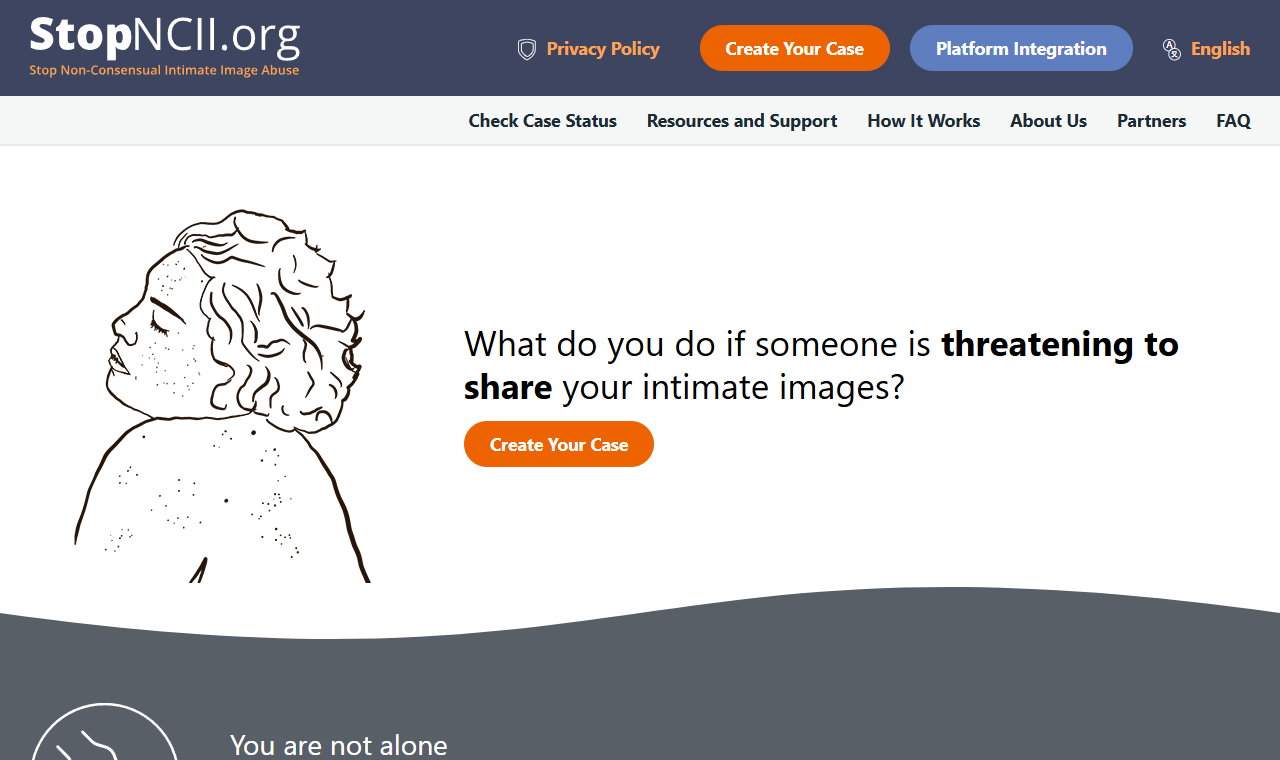
StopNCII.org creates a fingerprint of an image on your device, so the image itself never leaves it.
The short version
With adults, fiction and privacy, NSFW AI chat is your business. The lines are where real people come in: no minors, no real faces, no sharing without agreement. Stay behind those, set your own limits in the character before you start, and treat everything you type as something a stranger might one day read.