The same companion can feel dull in one conversation and vivid in the next, and the difference is usually the first two messages. This guide is about those messages.
Why openers fail
A language model predicts what comes next, based on everything already in the conversation - the mechanism in how an AI companion writes its reply. That has three practical consequences.
- It mirrors length. A one-line message gets a short reply; a paragraph gets a paragraph.
- It mirrors style. Write in present tense with small physical details and it will too. Write "hey wanna rp" and it will match that.
- It fills gaps with the most average option. If you do not say where or when, it picks the most common setting in its training - which is why so many scenes start in a coffee shop.
So the fix is not a magic phrase. It is giving the model enough of a story to continue.
The four parts of a scene
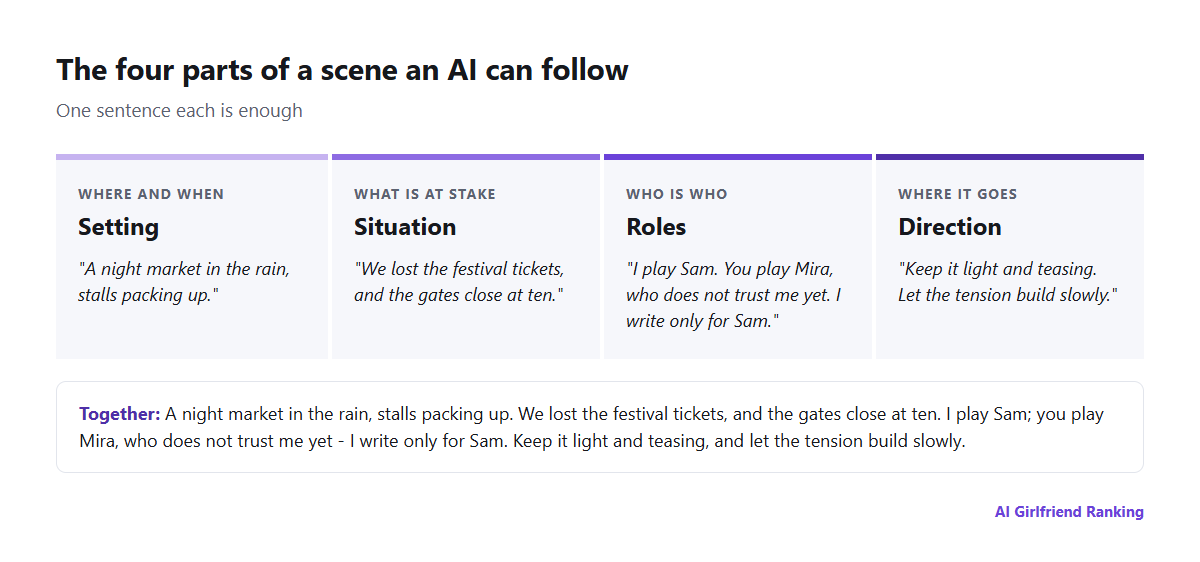
A scene the model can follow needs all four - one sentence each is enough.
Setting - where and when, with one or two concrete details. Not "a city", but "a night market in the rain, stalls packing up".
Situation - what has just happened, or what is at stake. A scene needs a reason to exist.
Roles - who you are, who the character is in this scene, and what each knows. This is also where you say that you play only your character.
Direction - what you want next: the tone, the pace, where the scene is heading, and any limits.
Weak and strong openers
| Weak | Strong |
|---|---|
| "Let's go on a date." | "Friday evening, a tiny Italian place you picked because it was quiet. It is not quiet - there is a birthday party at the next table. I arrive ten minutes late, soaked. Sorry. The bus broke down. You look amazing, by the way." |
| "Be my girlfriend on a trip." | "Day three of our road trip along the coast. The car's air conditioning died an hour ago and we have been arguing, half-seriously, about whose idea this was. I pull into a petrol station. You play yourself; I play only me. Keep it light and teasing." |
| "Fantasy roleplay please." | "A border town the night before a festival. You are the healer who patched me up this morning; I am a courier who cannot pay you. You have not decided whether you trust me. Slow burn - let the tension build over several scenes." |
The strong versions are not longer for the sake of it. Each one answers the four questions, and each ends on something the character can react to.
Steering once the scene is going
Out-of-character notes. Almost every model understands a short note in brackets as a message to the writer, not the character: (OOC: slow down - more dialogue, less description.) Keep them brief and put them at the end of your turn.
Time skips. A line such as [Two hours later, back at the flat.] moves a stalled scene forward more reliably than asking the character to change the subject.
Regenerate and edit. If a reply goes wrong, regenerate or edit it rather than arguing with it in the chat. Anything left in the history becomes an example the model will follow later.
Describe what you want, not what you do not. "She answers in short, dry sentences" tends to work better than "don't be so wordy". Mentioning the unwanted thing puts it in the text the model is continuing.
One instruction at a time. Ten rules in one message get averaged into none. Fix the most important thing, then the next.
Keeping a long scene together
Long roleplay eventually outgrows what the model can reread each turn, and early details fall out - the same limit described in how AI companion memory works. Two habits help:
- Summarise every so often. A three-line OOC recap - where you are, what has happened, what matters - puts the essentials back in view.
- Use the memory or notes field for facts that must never drift: names, relationships, injuries, promises.
If the character contradicts itself anyway, it is not ignoring you. It has confabulated a detail to fill a gap - see why AI companions invent memories. Correct it briefly and move on.
Where the character sheet fits
Scene prompts work on top of the character's permanent description. If the same problem appears in every scene - too formal, too eager, always the same pet name - fix it in the character, not scene by scene. Our character builder guide covers which fields matter.
And if a scene stops mid-way with a refusal, that is the app's filter rather than your prompt. What each kind of filter does, and why even permissive apps have a floor, is explained in content filters.