A slow burn is simple to describe and hard to get from an AI: tension that builds, moments that matter because they were earned, and a relationship that changes over time. Models do not naturally hold back. They need a structure, and you are the one who keeps it.
Why AI relationships peak too early
- Agreeableness. The character is built to please you, and escalating closeness pleases quickly.
- No sense of time. A model does not know that three days have passed unless you say so.
- Memory limits. Details from week one fade, so the story loses its foundation - see how AI companion memory works.
The result is the flatness described in when the novelty fades: nowhere left to go.
Plan the arc in stages
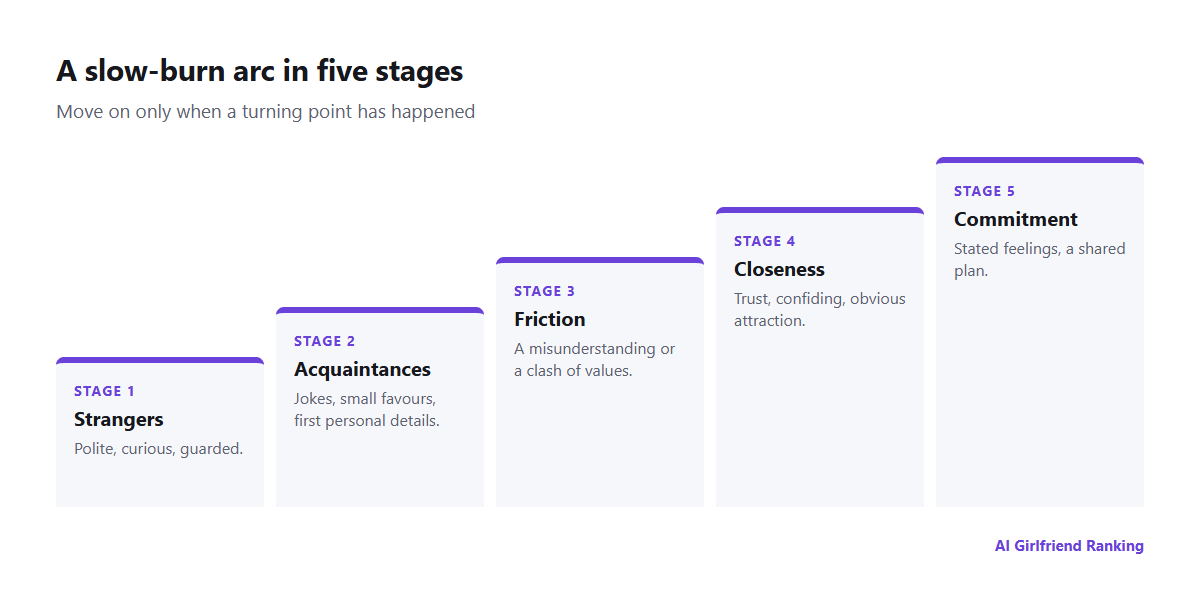
Stages move forward only when a turning point has happened.
| Stage | What it feels like | Turning point to move on |
|---|---|---|
| Strangers | Polite, curious, guarded | A shared problem or a chance meeting again |
| Acquaintances | Jokes, small favours, first personal details | One of you asks for help |
| Friction | A misunderstanding or a clash of values | An honest conversation that repairs it |
| Closeness | Trust, confiding, obvious attraction | A choice that costs one of you something |
| Commitment | Stated feelings, a shared plan | Whatever your story needs next |
Decide roughly how many sessions each stage should last before you start. A week per stage is a good default.
Tell the character about the pacing
Put pacing into the character's description or an early out-of-character note:
(OOC: This is a slow burn. We are strangers at the start. She is guarded and does not fall for me quickly. Move the relationship forward only when something important happens in the story, never on its own. Keep physical affection out of the first two stages.)
The technique is covered in roleplay prompts that work.
Pacing rules that keep the tension
- One step per session. Each evening moves the relationship a little. Resist doing the whole arc in one night.
- Let things be unresolved. End sessions on a question, not a resolution.
- Give her a life. A job, friends, a problem of her own. Scenes that are not about the relationship make the ones that are about it land harder.
- Use time skips. [Three days later.] signals that time has passed and stops the model treating every session as the same evening.
- Allow setbacks. A fight or a misunderstanding is not a failure of the app; it is the middle of a good story.
Keep a story log
Memory is the weak point of every long arc. Keep a short log in a note on your phone or computer:
- Where the story is: stage, last scene, open threads.
- Fixed facts: how you met, key promises, important dates.
- Her voice: two or three lines of dialogue that sound exactly like her.
At the start of each session, paste a short recap:
(OOC: Recap - we met at the night market three weeks ago. Last time we argued about the job offer and she left without saying goodbye. It is now two days later.)
Put the permanent facts in the app's memory or notes feature, where available. Our guide to switching apps uses the same kind of document - it doubles as insurance if you ever move.
When the arc ends
Arcs end. That is what makes them arcs. When the story reaches its natural end, you can start a new one with the same character - a new setting, a new problem - or let it rest. Many people find a finished story more satisfying than a relationship that simply goes on at the same level forever.