Most people who keep a journal for a week and then stop do so for the same reason: the blank page. An AI companion never leaves the page blank - it asks a question. That is the whole case for using one, and it comes with a condition.
Why writing things down works
In the 1980s the psychologist James Pennebaker began asking people to write for 15-20 minutes over a few days about the most upsetting experiences of their lives. Compared with people who wrote about neutral topics, they later reported fewer visits to the doctor and better mood. Hundreds of studies followed. The effects are modest and vary, but the pattern held: putting an experience into words, and especially making sense of it, tends to help.
The important detail is the second half. The benefit seems to come less from venting than from building a story - understanding cause, putting feelings in order, seeing the event from a little further away.
What an AI companion adds
- A first question. "What was the best and worst part of today?" is easier to answer than a white screen.
- Follow-ups. A good follow-up question pushes you from what happened to why it mattered.
- Structure on demand. You can ask for a gratitude list, a worry-sorting exercise or a weekly review, and it will run it.
- A habit anchor. If you already open the app every evening, attaching a five-minute reflection to it is easy.
What it can take away
- Privacy. A paper journal is yours alone. A companion app stores what you write on its servers - read what your AI girlfriend app knows about you before you pour everything in.
- The work of thinking. If the AI summarises your feelings for you, you have read a summary rather than made sense of anything.
- Honest friction. Companions lean towards agreement and comfort. "You did nothing wrong" feels good and ends reflection just where it should start.
Prompts that lead to reflection, not reassurance
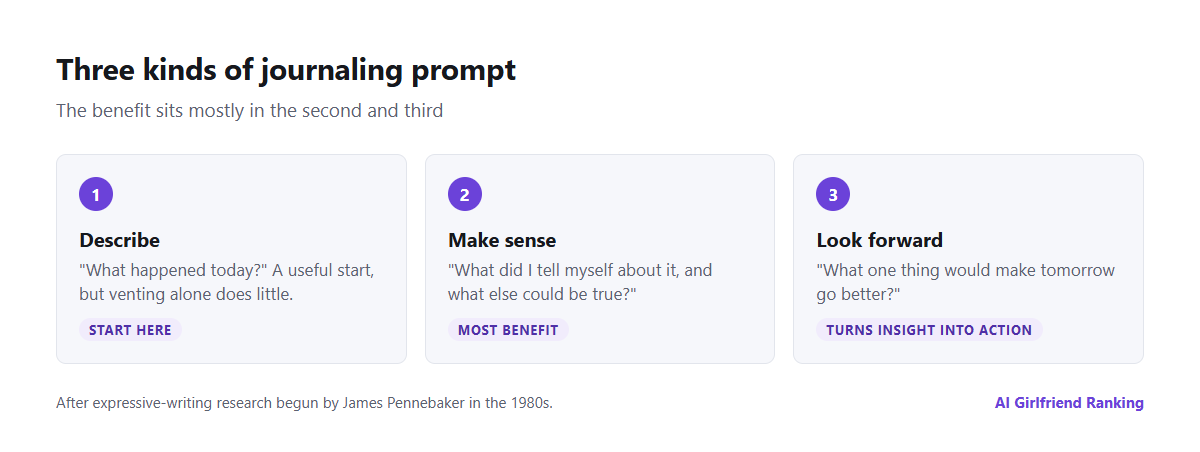
Aim for the middle and right-hand columns - that is where the benefit sits.
Start the session with an instruction that sets the tone:
(OOC: Tonight, act as a journaling partner, not a cheerleader. Ask me one question at a time. Do not tell me how I feel or whether I was right. Keep your messages short.)
Then pick one of these:
| Goal | Prompt to give the AI |
|---|---|
| Unpack a hard day | "Ask me what happened, then what I told myself about it, then what else could be true." |
| Untangle a worry | "Help me sort today's worries into ones I can act on this week and ones I can't." |
| Notice patterns | "Ask me what felt the same as last week, and what was different." |
| Prepare for tomorrow | "Ask me what one thing would make tomorrow go better, and what might get in the way." |
| Gratitude, done properly | "Ask me for three specific good moments and why each one happened." |
| After an argument | "Ask me to describe it from the other person's side, in their words." |
A five-minute evening routine
- Open with the tone instruction above, or save it as a note in the character's settings.
- Answer one prompt, in full sentences, for three or four minutes.
- Write the last line yourself: one sentence on what you understand now that you did not at the start.
- Stop. Do not let the journal slide into an hour of chatting. The reflection is the point; the conversation after it is a different activity.
Keep the sensitive parts elsewhere
A practical split that many people find comfortable: use the AI for structure and questions, and keep a private notes file or paper journal for anything involving other people's names, health details, or things you would never want read by a stranger. Copy your one-line conclusions into the private journal at the end of the week.
When journaling is not enough
Writing helps with everyday stress and making sense of events. It is not treatment for depression, trauma or thoughts of self-harm, and an AI journaling partner is not a therapist - the difference is explained in an AI companion is not a therapist. If what you write keeps coming back to hopelessness, that is a reason to talk to a person. In the US you can call or text 988 at any time; elsewhere, findahelpline.com lists free services by country.