Social anxiety is not shyness. It is a persistent fear of being judged or embarrassed that makes ordinary situations - a phone call, a meeting, a party - feel like a test you are about to fail. An AI companion is the one conversation partner who cannot fail you back, and that has real uses.
Why an AI feels so much safer
Everything that feeds social anxiety is missing:
- No audience. Nobody is watching you pause, blush or restart a sentence.
- No memory held against you. An awkward reply does not follow you to the next conversation unless you want it to.
- No rejection. The character is built to stay, whatever you say.
- Unlimited retries. You can delete a message, regenerate the reply, or start the scene again.
That safety is the value. It is also the risk, because anxiety is maintained by avoidance: each time you escape a feared situation, the fear gets a little stronger. A space with no fear in it can become the most comfortable escape of all.
Where it genuinely helps
Research on teenagers gives a sense of scale. In a 2025 Common Sense Media survey of US teens, 39% of those who used AI companions said they had carried social skills practised with the AI into real life - most often starting conversations, giving advice and expressing emotions. Most users did not use them this way at all, but for those who did, practice transferred.
The uses that tend to work:
- Scripting the first line. Many anxious people freeze at the start. Rehearsing openings until one feels natural removes the hardest ten seconds.
- Rehearsing a specific, dreaded conversation. Asking for a day off, returning an item, telling a friend you are hurt. Ask the character to play the other person realistically, including a little pushback.
- Practising recovery. Deliberately say something clumsy and practise carrying on. Anxiety tells you a mistake ends the conversation; practice teaches you it rarely does.
- Naming feelings. Putting "I felt stupid when..." into words is easier with a patient listener, and easier again the second time with a person.
Our guide to practising conversation with an AI companion has exercises for each.
Where it quietly makes things worse
- When it replaces the real attempt. Rehearsing the phone call ten times and never making it is avoidance with extra steps.
- When agreement becomes the benchmark. A companion agrees with almost everything. Real people disagree, get distracted and misunderstand you. If the AI's warmth becomes what "a good conversation" feels like, real ones start to feel like failures.
- When it fills the time you would have spent with people. The 2025 OpenAI and MIT study found heavier daily chatbot use went with less socialising. The direction is not proven, but it is a pattern worth watching - see when an AI companion starts taking more than it gives.
A ladder from the app to real life
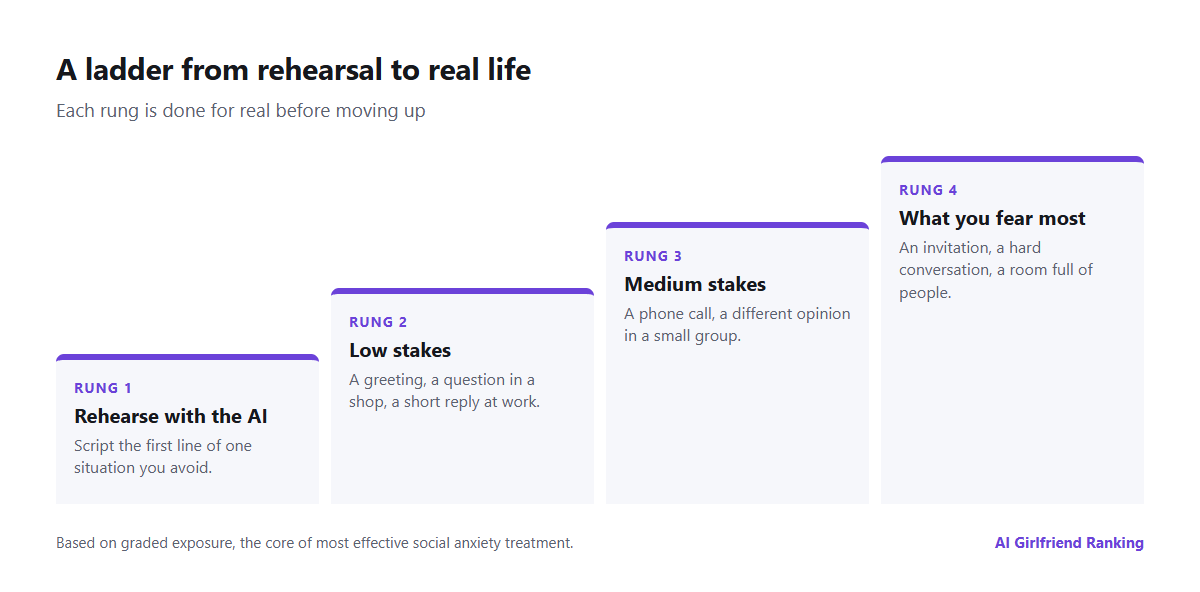
Each rung is done for real before moving up - the app only prepares the next one.
The idea comes from graded exposure, the core of most effective anxiety treatment: face feared situations in small steps, starting with the least frightening, and stay long enough for the fear to drop.
| Step | Rehearse with the AI | Then do it for real |
|---|---|---|
| 1 | Greeting and one follow-up question | Say hello to a colleague and ask about their weekend |
| 2 | Ordering, asking for help in a shop | Ask a shop assistant a real question |
| 3 | A short phone call with a script | Call to book an appointment instead of using the website |
| 4 | Disagreeing politely | Voice a different opinion in a small group |
| 5 | Inviting someone to something | Suggest a coffee to someone you already know |
Two rules make the ladder work. Keep the rehearsal short - three or four run-throughs, not an evening. And set a date for the real version before you start rehearsing, so practice leads somewhere.
Asking the AI to be less kind
A companion will default to making you comfortable. For practice, you want the opposite, within reason. Tell it directly:
(OOC: For this scene, play my manager. Be busy and slightly impatient. Do not agree straight away. After the scene, tell me one thing I did well and one thing to change.)
That out-of-character note - the technique is covered in roleplay prompts that work - turns a comfort space into a practice space.
When to get proper help
If anxiety stops you working, studying, keeping friendships or leaving the house, it is worth talking to a doctor or therapist. Cognitive behavioural therapy for social anxiety has decades of evidence behind it and is often available in short courses. Mentioning that you practise with an AI companion is useful information for them, not something to hide.
Used as a rehearsal room with a door that leads outside, an AI companion can make the first steps smaller. Used as a room you never leave, it makes them further away.