In most apps a "selfie" is not a photo from a camera. The chat model writes a description of the scene, and a separate image model paints it. Everything below follows from that - the mechanism is explained in how AI girlfriend images and voice work.
Why pictures drift
- Each image starts from scratch. Without an anchor, the model redraws the face every time.
- The description is rewritten. If the chat model paraphrases the character's look slightly differently, the face changes.
- Busy requests crowd out identity. A complicated scene leaves less room for the details that make her recognisable.
Some apps solve this with a fixed reference image or a model trained on the character; in our testing, Candy AI kept the same face for the longest. Where the app does not, the fixes below matter more.
Lock the look first
Before asking for any photos, make sure the character's appearance is written down precisely in the builder or description. Vague traits ("pretty, dark hair") give the model too much freedom. Concrete ones give it an anchor:
| Too vague | Concrete |
|---|---|
| Pretty, dark hair | Shoulder-length straight black hair with a fringe |
| Nice eyes | Green eyes, thick eyebrows |
| Slim | Slim build, 1.70 m, athletic shoulders |
| Stylish | Usually wears oversized knitwear and silver hoops |
Keep that block the same forever. When a picture looks wrong, compare it with the block rather than rewriting the block to match the picture.
What a good request contains
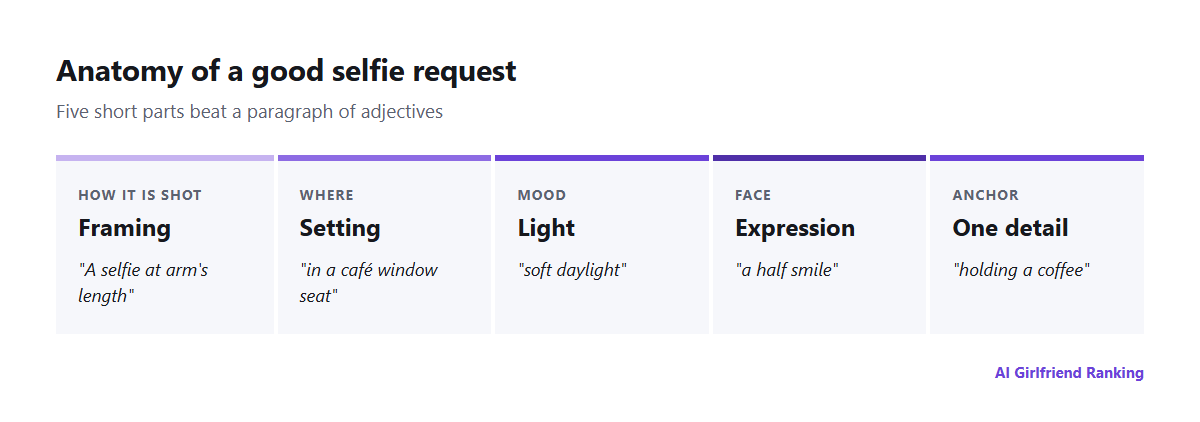
Five short parts beat a paragraph of adjectives.
- Framing. Selfie at arm's length, mirror photo, portrait from the waist up, full body.
- Setting. A café window seat, a kitchen at night, a beach at dusk.
- Light. Soft window light, warm lamp light, harsh flash, golden hour.
- Expression. Laughing, sleepy, focused, a half smile.
- One detail. Holding a coffee, hair tied up, wearing a raincoat.
"A selfie at arm's length in a café window seat, soft daylight, half smile, holding a coffee" will usually beat a long list of adjectives about beauty.
Habits that save credits
- Change one thing at a time. If the light is wrong, change only the light. Changing everything makes it impossible to learn what worked.
- Ask in chat first, generate second. Ask the character to describe the photo she would send, adjust the description in text, then request the image. Text is free or cheap; images are not - see the real cost of AI image generation.
- Reuse what worked. Keep a note of the requests that produced good pictures and reuse their structure.
- Know the cap. Many plans limit images per day or month. Check before a long session.
Keeping it consistent across weeks
- Keep the appearance block unchanged.
- Mention a signature detail in most requests - the same earrings, the same hairstyle.
- Avoid extreme angles and heavy effects, which distort faces most.
- If the app offers a "reference" or "base image", choose it carefully and keep it.
Privacy and consent
Generated images are stored on the company's servers, often at addresses that are more public than you would expect - see where your pictures actually live. Two rules follow:
- Never upload photos of real people to base a character on. Face-swap features have been used to create non-consensual sexual images of real women, and exposed storage in 2025 made thousands of them public.
- Think twice about your own face. It creates an image of you in a database you do not control.
A good AI selfie is mostly a matter of being specific once, and consistent after that. The model does the painting; you decide how much of the picture is left to chance.