Messenger bots have a real appeal. Your AI girlfriend sits in the same list as your friends, notifications work out of the box, and voice notes feel natural. The trade-off is that you are talking to a service with none of the structure an app store or a proper website imposes.
Why they appear in messengers at all
- No app store review. Apple and Google restrict sexual content and review apps before listing them. A messenger bot skips that step entirely - the rules are covered in browser or app store.
- Almost no cost to launch. A bot needs a server and a model, not an app.
- Built-in distribution. Channels, groups and forwarding spread links quickly.
The first influencer AI clone, CarynAI, ran through Telegram in 2023 and charged by the minute. When its operator's company collapsed, users lost access overnight.
What changed on WhatsApp
In October 2025 Meta changed the terms for WhatsApp's business platform to ban general-purpose AI chatbots - bots whose main product is open-ended conversation with an AI. The ban took effect on 15 January 2026, and major assistants including ChatGPT and Perplexity left the platform. Business bots for customer service, bookings and orders are still allowed, and Meta's own assistant remains.
The practical effect for companion users: a WhatsApp number offering you an "AI girlfriend" is now either operating against the platform's rules, and likely to be cut off, or not an AI service at all.
What goes wrong on Telegram
Telegram allows bots freely, and the category includes some of the most harmful services online. In 2024 Wired found at least 50 "nudify" bots claiming to create explicit images of real people from ordinary photos, together listing more than 4 million monthly users. Telegram removed them after being contacted; replacements appeared.
Companion bots on Telegram are not all like that, but they share the structural problems:
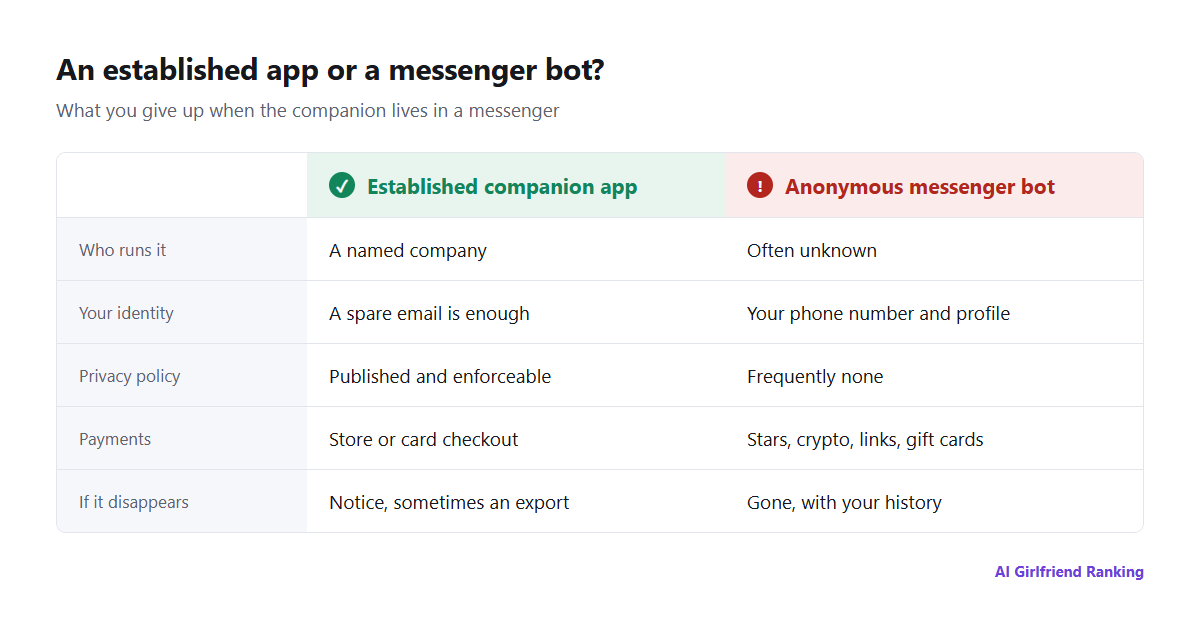
What you give up when the companion lives in a messenger.
| Established app | Anonymous messenger bot | |
|---|---|---|
| Who runs it | A named company | Often unknown |
| Privacy policy | Published, enforceable | Frequently none |
| Deleting your data | A process, with legal rights behind it | Usually impossible to request |
| Payments | App store or card checkout, refundable | Stars, crypto, links, gift cards |
| Content rules | Filters, age checks, legal duties | Whatever the operator decides |
| If it disappears | Notice, sometimes export | Gone, with your chat history |
The specific risks
- Your phone number is the account. Unlike an app where you can use a spare email, a messenger bot sees your real number and profile.
- Chats are not end-to-end encrypted with a bot. The bot's operator receives every message in readable form, as any AI service must - and in Telegram's case, ordinary chats are not end-to-end encrypted anyway.
- Payment outside a checkout. Many bots sell credits through links or crypto. That is also exactly how scams take money - see romance scams in the age of AI companions.
- Images of real people. Bots that invite you to upload photos to "make her look like someone" are offering deepfakes. Creating or sharing sexual deepfakes of real people is illegal in many places.
- Sudden disappearance. Bots are banned, abandoned or renamed constantly, taking your history with them.
If you still want one
- Start from the company's website, not from a link in a channel or group. A legitimate app that offers a Telegram bot lists it on its own site.
- Find the privacy policy and the company name before sending anything personal.
- Pay only through the platform's official methods or a proper checkout, never through crypto or gift cards.
- Never upload photos of real people, including yourself.
- Keep the conversation there. A bot that asks you to move to another messenger or a private link is a red flag.
The convenience of a messenger bot is real. For most people, though, a companion app or its web version gives the same conversation with a company behind it, a policy you can hold it to, and a way out when you want to leave.