These two things should never be confused, and mostly they are not. But they share a surface - warm messages, attention on demand, an invitation to pay - and scammers have noticed that people used to AI companions are used to both.
The scale of the problem
Romance fraud is one of the most expensive scams in the United States. People reported losing $1.14 billion to romance scams to the Federal Trade Commission in 2023, with a median loss of $2,000 - the highest of any impersonation scam. In the first nine months of 2025 alone, reported losses passed $1.16 billion across more than 55,000 reports.
Those are only the cases people reported. Police and consumer agencies consistently describe romance fraud as heavily under-reported, largely out of embarrassment.
The FTC also found that nearly 60% of people who lost money to a romance scam in 2025 said it started on social media. The pitch was tailored to their profile, and the money request arrived as either a sudden crisis or a friendly tip about an investment platform.
What AI has changed about romance fraud
Romance scams used to have tells: broken English, the same stock photos showing up in reverse image searches, excuses to avoid video. AI has removed most of them.
- Fluent messages in any language. A scammer no longer needs to write well, or even speak your language.
- Photos that do not exist anywhere else. Generated faces defeat reverse image search.
- Video and voice that can be faked live. Face-swapping and voice cloning work in real time on consumer hardware.
- Scale. One operator can run dozens of convincing conversations at once with a chatbot doing the typing.
The result is that the old advice - "ask for a video call" - no longer settles anything.
Four signs that separate an app from a scam
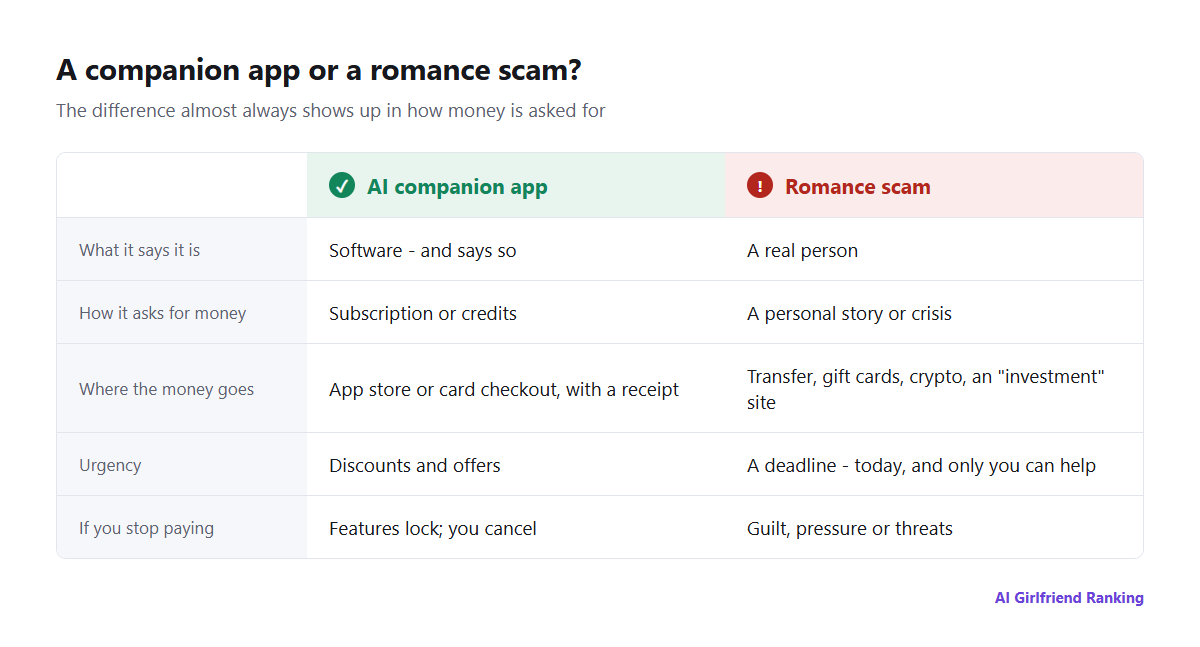
The line between a companion product and a con.
1. It claims to be a human. A companion app tells you it is an AI, and in a growing number of US states it is legally required to - see AI companion laws in the US. A "person" who met you online and turns out to be unusually available, unusually agreeable and unwilling to meet is the reverse.
2. Money moves outside a checkout. Companion apps charge through an app store or a card payment page, with a receipt and a cancellation route. Scams ask for bank transfers, gift cards, cryptocurrency, or deposits on an "investment platform" you have never heard of.
3. There is a crisis with a deadline. A hospital bill, a customs fee, a frozen account, a ticket home - always urgent, always solvable only by you, always today. Products do not do this; people running a con do.
4. It wants you somewhere else. The conversation is moved quickly to WhatsApp, Telegram or another private messenger, away from the platform's moderation and your chat history.
Any one of these is a reason to stop. Two together are close to certain.
Scams aimed at companion-app users specifically
Some fraud targets people who already use AI companions, because they are known to pay for digital intimacy.
- Lookalike apps. Copies of well-known apps with slightly different names, in the stores or as downloads from ads. Install only from the official store listing or the company's own site.
- "Premium unlock" offers. Cheap lifetime access, cracked versions or credit bundles sold through Telegram channels or social media. At best you lose the money; at worst you hand over a login.
- Account takeover. Phishing emails styled as billing problems. A hijacked account exposes your full chat history - the protections are in account security for AI companion apps.
- Sextortion. Intimate images, whether real or generated, used to demand payment. Anything shared into an app or a chat can escape it - see where your pictures actually live.
- "AI girlfriend" accounts on social media. Profiles that present as an AI or a model and push you to a payment link in a private message. A real product has a website and a checkout, not a DM.
If you have already sent money
- Stop sending. Including the "last payment to release everything", which is always part of the script.
- Call your bank or card issuer immediately. Transfers and card payments can sometimes be stopped or disputed if you move fast.
- Keep everything - messages, usernames, wallet addresses, receipts. Do not delete the conversation, even though you will want to.
- Report it to ReportFraud.ftc.gov and to the FBI at ic3.gov if you are in the US, or to your national fraud reporting service elsewhere.
- Ignore recovery offers. People who promise to get your money back for a fee are the second half of the same scam, and they target people who have just reported a loss.
ReportFraud.ftc.gov - the FTC's reporting site.
The simple rule
An AI companion can be overpriced, pushy about upgrades or disappointing, and still be exactly what it says it is. A romance scam is a lie from the first message. The test is almost always money: a companion only ever asks for it through its own checkout. Anything that asks for it another way is not a companion, whatever it calls itself.