The question feels new, but the structure is old. Couples have always had to decide where the line sits for flirting, pornography, close friendships and online chats. An AI girlfriend adds a new object to an old negotiation.
What people actually think
In Match's 2025 Singles in America study, run with the Kinsey Institute, 16% of US singles said they had interacted with AI as a romantic companion - a figure that rose to a third among Gen Z. Asked whether having an AI boyfriend or girlfriend counts as cheating, 40% said yes.
That is a large minority, not a consensus. It means that in a typical relationship there is a real chance that one partner sees it as harmless and the other does not - and neither is wrong. They simply have different agreements in their heads.
Why the answer differs between couples
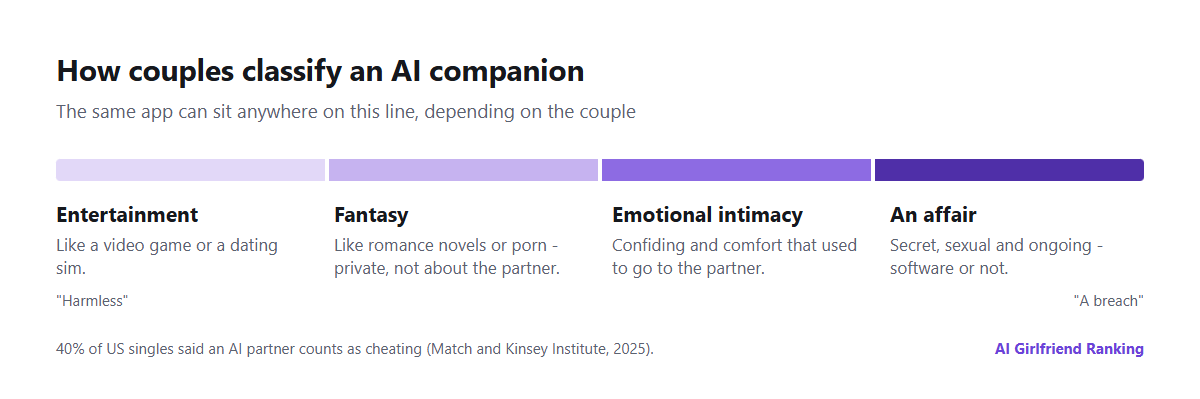
Where a couple places it depends on what they already consider private, shared or exclusive.
People tend to classify an AI companion by analogy to something they already have an opinion about:
- "It's a game." Characters, scenes, roleplay - no more a relationship than a dating sim.
- "It's fantasy." Like pornography or erotic fiction: private, not about the partner, acceptable or not depending on the couple's existing view of those.
- "It's emotional intimacy." If you are confiding feelings, getting comfort and looking forward to it, it resembles a close emotional bond - and some people consider emotional exclusivity part of monogamy.
- "It's an affair." Secret, sexual and ongoing, with time and money going into it. For some people the fact that the other party is software changes nothing.
What partners usually object to
In practice, the objection is rarely the technology. It tends to be one of these:
| What hurts | Why it lands | What helps |
|---|---|---|
| Secrecy | Discovering it feels like being deceived, whatever "it" was | Telling them first, not being found out |
| Time | Evenings with the app are evenings not together | Keeping it to times that are genuinely yours |
| Confiding | Feelings go to the app instead of the partner | Bringing important things to the relationship first |
| Sexual content | Feels like a breach if it was never discussed | Being specific about what the app is used for |
| Money | Subscriptions and credits add up and can feel hidden | Treating it like any other shared-budget spend |
Notice that most of these are fixable without giving up the app. Secrecy is the exception: it turns almost any of the others into a breach of trust.
A test that settles most cases
Ask yourself one question: would I be comfortable if my partner read the last week of chats over my shoulder?
If yes, you are probably on the right side of your own agreement, and the conversation with your partner is mostly about letting them know. If no, the reason you would be uncomfortable is the thing to talk about - whether that is the content, the feelings, or the time.
How to bring it up
- Choose a calm moment, not in the middle of an argument or right after being caught.
- Say what it is, concretely. "I use an app where I chat with an AI character, mostly in the evenings, and sometimes it gets flirty."
- Say what it is for you. Stress relief, fun, curiosity, loneliness when they are away. Honesty here makes the rest easier.
- Ask where their line is, and listen. They may be relaxed about the chat and not about the explicit content, or the other way round.
- Agree something specific. No NSFW, no confiding about the relationship, only when apart, or no limits at all. Couples that write down even one rule argue about it far less later.
Our guide to telling people about your AI companion covers the conversation in more detail, including what to do if it goes badly.
If it is your partner who uses one
It is normal to feel hurt, confused or even compared. Before deciding what it means, ask what it is for them - many people use companions for reasons that have little to do with their partner. Then state your own line clearly. You are allowed to have one, even if other couples would not.
The honest bottom line
An AI girlfriend is not cheating by definition, and it is not harmless by definition either. It is a new thing that couples have to place within the agreements they already have. The couples who handle it well are not the ones with the most relaxed rules. They are the ones who said something before it became a secret.